Showing posts with label Eastern USA. Show all posts

Wednesday, July 11, 2018

Eastern USA: South with the Spring (Part 2)

From Charlottesville we drove (on April 27, 2016) down out of the Virginian mountains to the coastal plain, where we would spend the remainder of our trip. Our first real taste of the Atlantic coastline was a magnificent stretch of sand at Virginia Beach, Virginia. This early in the season, though, it was occupied mostly by an assortment of gulls. The dark-mantled individual in this iPhone snap is a Lesser Black-backed Gull (Larus fuscus), a species that has become increasingly common in the western side of the Atlantic.

One of the odder sights on the beach is a tiny museum devoted to the art of waterfowl carving.

Various local carvers take turns displaying their craft inside an old beach house.

The results (many of which are for sale) range from functional decoys to an attractively-carved Gadwall, obviously intended for a display shelf.

We spent a night in Morehead City, North Carolina, and drove out the next morning onto the most southerly of the Outer Banks islands, dominated by the resort community of Emerald Isle. Much of the Atlantic side of the island is private property, but there are some really beautiful public beaches, almost empty of people this early in the year.  This is the beach at Pine Knoll Shores.

A stroll on the beach gave me a chance to do a bit of birding.

Laughing Gull (Leucophaeus atricilla)
Laughing Gulls (Leucophaeus atricilla) dominate the beach, as they do along much of the eastern seaboard. April is the courtship season for these gulls, and this pair seem to be in the throes of making (or renewing) acquaintances.

Willet (Catoptrophorus semipalmatus)
The Willet (Tringa semplalmata) is a year-round resident on southeastern beaches, nesting in the saltmarshes nearby.

Willet (Catoptrophorus semipalmatus)
It appears to be a particularly plain creature, but when it flies it reveals striking black-and-white wings.  It’s not doing that here, of course.

Laughing Gull and Willet
Paths crossing on the beach: a Laughing Gull and a Willet.

Whimbrel (Numenius phaeopus)
This Whimbrel (Numenius phaeopus), on the other hand, is undoubtedly just refueling here before heading north to its nesting grounds on the tundra.

Sanderling (Calidris alba)
I am far from the first to be convinced that Shakespeare had Sanderlings (Calidris alba) in mind when he had Prospero invoke “ye that on the sands with printless foot /Do chase the ebbing Neptune and do fly him / When he comes back”.

Sanderling (Calidris alba)
Sanderlings do that sort of thing as a matter of course. It is not a game; the ebbing waves may momentarily turn up small creatures living among the sand grains, and by chasing the waves the Sanderlings have a chance to snatch them up before they can burrow to safety.

Our next stop on our journey south was the boardwalk at Jones Island, NC, an attractive bit of coastal saltmarsh and evergreen forest, now mostly protected as part of Hammock Beach State Park.

I am always happy to see a well-labelled trail, especially one that identifies plants.  Otherwise, how would I know that this is Black Needlerush (Juncus roemerianus), a plant valued for its ability to tolerate soil contaminated with diesel oil and other pollutants.  It is a dominant species in the saltmarsh.

Blackberries (Rubus spp.) are attractive enough as flowers, but I confess I prefer them when they are in fruit!

The commonest honeysuckle in the Carolinas is probably the introduced (and extremely aggressive) Lonicera japonica, and that is, I suspect, what this is.

Northern Mockingbird (Mimus polyglottos)
The boardwalk itself attracted a curious Northern Mockingbird (Mimus polyglottos)...

American Bird Grasshopper (Schistocerca americana)
...and this rather striking American or American Bird Bird Grasshopper (Schistocerca americana), a common species that can be a serious agricultural pest.

Our route southward took us onward through South Carolina, but left little opportunity for nature-watching except for a bit of a morning poke-around at the edge of a saltmarsh behind our hotel in Beaufort, in the state’s southeastern corner.

Though we were a few miles from the open ocean there were still crabs here, scuttling underfoot as I scrambled about trying to photograph them.  This, of course, is a male Fiddler Crab, probably either a Mud Fiddler (Uca pugnax) or a Red-jointed Fiddler (Uca minax). 

Marsh Crab (Sesarma reticulatum)
These crabs, lacking the impressive 'fiddles' of the fiddlers, are Marsh Crabs (Sesarma reticulatum).  This species has a rather odd ecological history: after humans overfished its major predators, it underwent a population explosion.  Marsh Crabs are herbivores, and the exploded population proceeded to eat its way through large tracts of creekside and saltmarsh vegetation.  To the rescue came, surprisingly, an exotic species, the Green Crab (Carcinus maenas), which both ate the Marsh Crabs and evicted them from their burrows - a rare case (though perhaps not as rare as we usually believe) of an invasive species becoming a key factor in restoring a native ecosystem.

By now we were in the Deep South, and for a naturalist one of the most obvious signs of that were the clumps of grey-green Spanish Moss (Tillandsia usneoides) festooned over the limbs of almost every tree in sight. Despite its name and appearance, Spanish Moss is a bromeliad, a relative of the pineapple.

Even more Spanish Moss, draped over the spreading limbs of Live Oaks (Quercus virginiana): a sure sign that we were now in the Deep South, in the historic center of Savannah, Georgia, not far from the Florida border.

Saturday, June 16, 2018

Eastern USA: South with the Spring (Part 1)

In April 2016 Eileen and I took on the task of bringing my elderly mother, a still-sharp 94-year-old, back to Canada from her winter home in Boca Raton, Florida. We would certainly have to fly home once we got there, but for once we decided to travel south by road. Eileen had long wanted to do this, but I had always balked at the idea for fear of running into foul winter weather en route. This time it would be different - a week-long, balmy spring drive, in a rented car that we would leave in Boca - and to make the trip even more pleasant we invited our friends Cynthia and Lau to come along. They had already travelled with us to the Maritimes, so we knew that we could get along in the confines of an automobile.

There is more than one way to get from Ontario to Florida. I selected a route through country that was new to me, passing through nine states (including Florida) including two, North and South Carolina, that I had never visited before. As the only naturalist in the group, I was under no illusions that I would get much nature-watching in, but there were nonetheless odd moments en route to  remind me that spring was unfolding and migrating birds were streaming past us. This entry is hardly the equivalent of Edwin Way Teale’s classic North with the Spring, but it should provide, at least, a taste of the season.

Our first day (April 24, 2016) was mostly involved in getting from here to there - ‘there’, in this case, being a roadside hotel in Altoona, Pennsylvania. The next day was altogether more interesting. We were headed for my cousin Joe Greenberg’s house in Charlottesville, Virginia, but instead of going there directly we took a decidedly scenic route: the famous Skyline Drive through Shenandoah National Park.

The park protects the forests (logged over in the past, but still impressive) of the Blue Ridge (not to be confused with the Blue Ridge Mountains of Tennessee), the easternmost of the three highland spurs that form the northern extension of the Appalachian Mountains. The Skyline Drive, built by Franklin D. Roosevelt’s Citizen Conservation Corps during the Great Depression, traverses the ridge top for 103 miles. We were unable to drive the whole of it - the southern portion had been closed after a forest fire swept through 8000 hectares of the park during the previous week.

Climbing and, later, descending from the ridge top gave us an object lesson in climatic succession. There is an ecological rule of thumb that says that every thousand feet of a North American mountain range you climb is equivalent to a hundred-mile journey to the north. So it was here. On our previous day’s drive south from Canada we had watched as the still largely leafless woodlands of Ontario gradually gave way to more and more fully leafed-out trees.

As we climbed the Skyline Drive, the situation rapidly reversed itself. When we reached the top - between about 2600 and 3200 feet above sea level - we found ourselves back among trees that had only begun to wake from dormancy.

Flowering Dogwood (Cornus florida)
We were not, though, back in Ontario. Carolinian plants, rare at home, had begun to assert themselves - Eastern Redbud (Cercis canadensis), which grows poorly in most of Ontario despite its name, and Flowering Dogwood (Cornus florida).

Flowering Dogwood (Cornus florida)
Around the Visitor’s Center the dogwoods were being visited by Eastern Tiger Swallowtails (Papilio [Pterourous] glaucus) and a single Zebra Swallowtail (Protographium marcellus), a butterfly I had never seen before, but the butterflies evaded my camera.

Eastern tent caterpillar (Malacosoma americanum)
A number of the trees were decorated with the webs of Eastern Tent Caterpillars (Malacosoma americanum).  My late professor J. Murray Speirs always referred to these objects as 'cuckoo food', and indeed North American cuckoos are among the few birds that will eat the caterpillars inside.

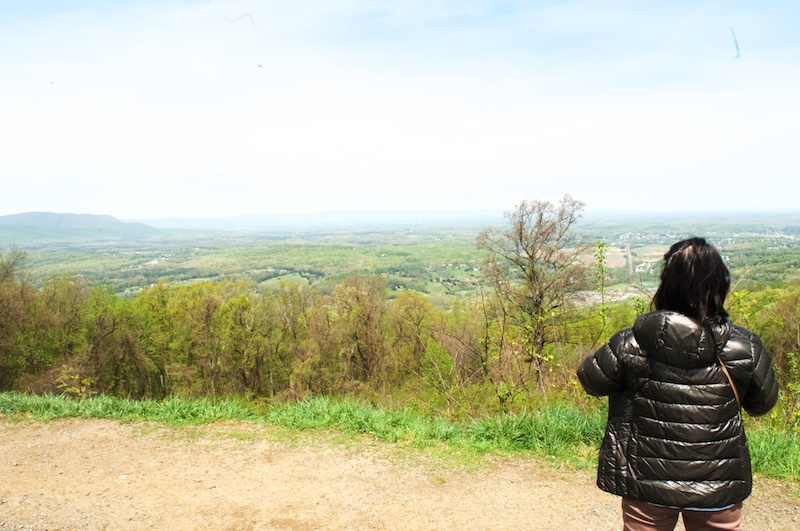
As we followed the drive we were treated to views of the fabled Shenandoah Valley far below us, still - as it has been for almost two centuries - dotted with farms.

Rufous-sided Towhee (Pipilo erythrophthalmus)
At one overlook, an Eastern Towhee (Pipilo erythrophthalmus) sang from atop a patch of shrubbery that he clearly regarded as his.

By the time we reached Charlottesville, where we were welcomed by Joe and his wife Sharon, we were truly back in the Carolinian Zone.

Joe and Sharon’s home backs on an attractive patch of woodland inhabited by White-tailed Deer (Odocoelius virginianus) and even the occasional wandering Black Bear (Ursus americanus). We didn’t see any, of course, but we were treated to the songs of a Tufted Titmouse (Baeolophus bicolor), common here but a rare bird in Canada.

American Tuliptree (Liriodendron tulipifera)
Just off Joe’s back porch I could see a number of American Tuliptrees (Liriodendron tulipifera), true symbols of the Carolinian Forest.  The interested reader can compare these leaves to those of the only other tuliptree in the world, the Chinese Tuliptree (L. chinense), which I photographed at the foot of Mount Huangshan back in 2010.

The highlight of our visit to Charlottesville was a fascinating look into the mind and home of one of America’s greatest pioneer scientists. Some 460,000 visitors have the same experience every year. I refer, of course, to Thomas Jefferson (1743-1826) and his famous hilltop house at Monticello (the name means ‘little mountain’ in Italian). 

Of course most people think of Jefferson as the third president of the United States (or, perhaps, as an unrepentant slave-owner), but Jefferson refused even to allow that honour to be engraved on his tombstone. Instead, he insisted on listing what he considered his three principal accomplishments: writing the Declaration of Independence and the Statute of Virginia for Religious Freedom, and founding the University of Virginia.

Unfortunately you are not allowed to take photographs inside the house itself, or I would show you evidence of Jefferson’s scientific bent: bones of the American Mastodon (Mammut americanum) he famously described, on view in the entrance hall with, among other things, antlers of the various species of American deer (plus the horns of a Pronghorn (Antilocapra americana) thrown in for good measure), a copy of Linnaeus’ Systema Naturae on his bookshelf (not his personal copy, but he did own one), and a small engraved portrait of the great German naturalist Alexander von Humboldt (one of Jefferson’s correspondents) on a wall.

Eastern Bluebirds (Sialia sialis)
Instead, you will have to be content with exteriors. Jefferson took forty years to build Monticello, and spent some of them in a tiny one-room building still standing on the site. Perhaps he would have enjoyed knowing that one wall of this original house is now a nesting ground for a pair of Eastern Bluebirds (Sialia sialis).

We took a tour of Jefferson’s garden, still maintained as he did (though perhaps, one supposes, without his extreme meticulousness).

Plants labelled TJ are varieties that we knew Jefferson grew.

I quite liked this parrot tulip, a type more popular in Jefferson’s day (and as any number of classic Dutch still-lifes prove, for some time earlier) than it is today.  In a way, it gave us another taste of the past.