Getting behind again -- too many good stories to tell!
 The lighthouse at Tanjung Tuan, near Port Dickson on the west coast of the Malay Peninsula, sits atop a wooded promontory overlooking the Straits of Malacca. Here, thanks to our friend Bing Lim, Eileen and I spent April 2-3 with the intrepid participants in the annual raptor watch organized by the Birding Group of the Malaysian Nature Society (Selangor Branch).
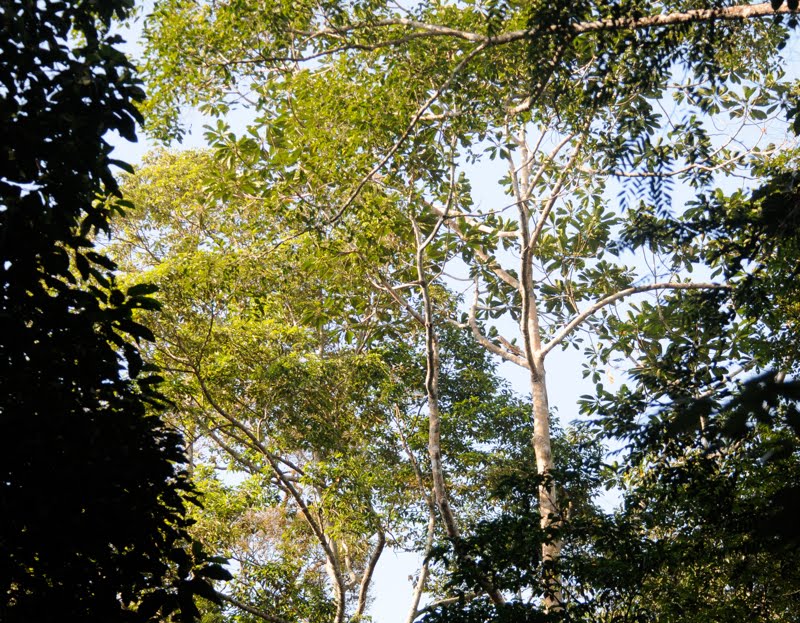
 The reason the promontory is still wooded, Bing told us, is that although Port Dickson is in the state of Negeri Sembilan, this isolated bit of land is officially part of the state of Melaka and thus somewhat immune to the development pressures in the surrounding area. The result is not only and excellent place to watch migrating raptors, but a nice little forest reserve.
 Here's an attractive epiphytic fern growing on a tree along the road.
...

 ...and here are two extremely attractive denizens of the forest - Dusky Langurs or Dusky Leaf-Monkeys (Trachypithecus obscurus).
 The raptor watch has been an annual event for quite some time, is officially held during one weekend in March, but the really keen watchers stay on duty for a whole month, counting the birds as they fly across the strait from neighbouring Sumatra.
 Watching birds from an attractive terrace by the seaside may not seem like a particularly strenuous pastime, but that reckons without the midday heat. The thermometer climbed on both days to 38° C. The canopy was a big help!
 Our intrepid team members included Khoo Swee Seng and his wife Carol, with Bing on the right.
 All eyes (well, most eyes) were glued to the waters of the strait, waiting for the raptors to arrive.
 Out on the strait itself, barges and container ships plied the waters....
 ...With a few small fishing boats nearer to shore.
 The rising temperatures made the waters below look quite attractive, if a bit murky!
 There were, of course, distractions as we waited for the raptors to arrive. One dead limb below us provided perches for a pair of Blue-throated Bee-Eaters (Merops viridis) and a Yellow-vented Bulbul (Pycnonotus goiavier)...
 ...And, on the second morning, for a Lineated Barbet (Megalaima lineata), here near the southern end of its range.
 Below the lighthouse parapet, a young Pin-striped Tit-Babbler (Macronous gularis) begged for food from its presumed parent (Note: this is the bird that was once known simply as the Striped Tit-Babbler until it was split from the Bold-striped Tit Babbler (Macronous bornensis), the form found in Borneo. The new name makes it sound as though it is clad in a business suit, which is clearly not the case).
 Red-Eyed Bulbuls (Pycnonotus brunneus) came in for a close look...
 ...While an Orental Magpie-Robin (Copsychus saularis) sang from a nearby perch.
 This Dollarbird (Eurystomus orientalis) used the lighthouse as a regular perch. The second shot shows how the bird got its name - the roundish wing-patches are supposed to resemble silver dollars.
 We adopted this Common Myna (Acridotheres tristis) as a sort of mascot - or perhaps it was vice versa! As the upper photograph shows, it seemed as affected by the midday heat as we were...
 A few Plantain Squirrels (Callosciurus notatus), the common garden squirrels of most of Malaysia, visited the nearby bushes. The lower shot may not show the whole animal, but it does give you a good view of its characteristically rusty belly.
 I'm afraid that I am not a good enough photographer to do much with swifts in flight, so you will have to take my word for it that the air around the lighthouse was swarming with them. This one, I think, is a House Swift (Apus affinis), but we also noticed some migrating Fork-tailed Swifts (Apus pacificus) and multitudes of swiftlets. Most of the swiftlets were plain birds with grayish rumps, and were probably examples of the vast number of hybrids that now swarm over much of Malaysia as a result of the boom in swiftlet farming. However, I also noticed some small white-rumped birds which may have been the resident Germain's Swiftlet (Collocalia germani), and a few large, dark individuals that may have been migrating Himalayan Swiftlets (C. brevirostris).
 We were there, of course, for bigger things, and although it was almost the end of the raptor migration eventually birds of prey started to arrive as the temperature rose and thermals started to form. White-bellied Sea-Eagles (Haliaeetus leucogaster) like these are probably local residents.
 Here's one with a Black-shouldered (or Black-winged) Kite (Elanus caeruleus) - a nice demonstration of how two birds of prey with somewhat similar patterns can differ so enormously in size and shape!
 Here is another eagle, this time an immature.
 A lone Pergrine Falcon (Falco peregrinus) swoops in amidst a pack of swifts....
 ...while knots of commoner raptors circle overhead. These are Oriental Honey Buzzards (Pernis ptilorhynchus), by far the most abundant species over the whole of the raptor watch period.
 These are Chinese Goshawks (or Chinese Sparrowhawks, if you prefer) (Accipiter soloensis), identifiable (even at some distance overhead) by their pale underwings and black wingtips. We saw several other species as well: Japanese Sparrowhawks (Accipiter gularis), Black Bazas (Aviceda leuphotes) and a sole Pied Harrier (Circus melanoleucos), all life birds for me, were standouts - though I confess I should like to have seen them closer to!
 Lim Aun Tiah carefully recorded all the details - this is a scientific survey, remember!
 Here is Bing performing another crucial survey function - keeping the local Long-tailed Macaques (Macaca fascicularis) away from our bananas... not always successfully, I might add...
 The pole is necessary - I tried shooing away a male with my hand and got a full-scale, very toothy threat display in response. Final score: macaque 1, blogger 0.
 The end of a successful two days, as Eileen celebrates with our happy team!
After the conservation debacle that was the CITES Conference in Doha (if you don't believe me, read the news reports), and a series of ghastly flight mixups, him and I find myself, with considerable relief, back in Malaysia! I'll be here until the middle of June, and I hope to be able to supply my eager readers (should there be any) with a greater frequency of posts that I have managed over the past several months.
 Let's get started: After a few days in Singapore, Eileen and I crossed over to the Malaysian state of Johor on March 30 for a visit the next morning to what is supposed to be one of the best low land birding areas on the peninsula, Panti Forest near Kota Tinggi.
 This is not primary forest, but its secondary forest habitat contains what is supposed to support one of the larger, or at least one of the easier-to-see, populations of one of Malaysia's most peculiar birds, the Rail-Babbler (Eupetes macrourus). Panti, however, appears to have changed, and not for the better. The famous (at least among birders) Bunker Road - so called because it starts off just north of a pair of immense World War II concrete bunkers flanking either side of the highway between Kota Tinggi and Mersing - is now marked with a large sign declaring that the area is a "Birding Sanctuary" and other signs warning of dire penalties for any who dare enter without permission.
 What this appears to mean is that the road entrance is now blocked by a guard house, where you will be informed that you need a permit, obtainable only in the state capital of Johor Bahru a good hour's drive away, to visit the site, and that the gate only opens at eight o'clock in the morning. I have no objection to permit requirements, in moderation, but anyone who thinks that this means that the habitat is now being protected with greater vigilance will not be pleased by the heavy traffic in cars, lorries and motorbikes whizzing back and forth along the road to a sand mine some 8 km into the forest.
 What is more, the road is being "improved" by bulldozers bent on rendering it sufficiently wide to prevent it from providing any decent roadside habitat for bird life. All in all, it is a bit difficult to see exactly what's designating this area as a sanctuary has amounted to, especially considering that the "official" opening of the site is supposedly still several months away.
 Okay, end of complaint (and over to you, Malaysia and Singapore birders who might want to do something about this situation). It's good to be back in Malaysia, and it's good to be back in tropical forest. I'll have to admit that as a birding destination, Panti was not a success. That said, as a welcome patch of greenery with myriad plant life and enough animal life (including a chorusing troop of White-handed Gibbons (Hylobates lar) which I not only heard but, briefly, saw) to keep any northern naturalist happy.
 For one thing, the road was often lined with flowers. This one, a common roadside plant (or, if you prefer, weed, as it is apparently not a native), is probably Melastoma malabathricum, the so-called Singapore "rhododendron" (though it is not a rhododendron, but a member of a quite different family, the Melastomataceae).
 This one appears to be Dillenia subfruticosa, endemic to the Malay Peninsula, Sumatra and Borneo but now widely planted elsewhere. It is locally known as simpoh air.
 This magnificent flowering vine is orange bauhinia (Bauhinia bidentata), a common plant on the Malay Peninsula
.
Cascades of it drape themselves over roadside trees all along the road through the forest.
 Other flowers in the forest are far subtler (and less easy for a non-botanist to identify), but add their touches of colour and form...
 Some, as is often the case with tropical forest flowers, spring directly from the trunks of trees, a condition called cauliflory.
 Here are some cauliflorous fruits, I believe from a sort of fig.
 Some trees flower high in the canopy, and their flowers are only obvious when they fall to the forest floor.
 I am always fascinated by the variety of leaf shapes among the plants in a tropical forest. Here are two contrasting examples; the second photo shows leaves with elongated "drip tips" that help drain away rainwater, a common feature of tropical forest trees in many parts of the world.
 This is a ginger (Family Zingiberaceae), demonstrating the habit of many gingers of growing with a spirally twisted stem - a very neat arrangement for making sure that each leaf gets maximum exposure to the sun.
 Though most of Panti's trees are fairly small (as you would expect in a secondary forest), occasionally a giant from older days survives, supported -- as is this tree -- by huge, flaring buttress roots.

 On a dark forest trail, a patch of gleaming white reveals the decaying fruiting body of a fungus.
 Dragonflies along the roadside included this male Orchithemis pulcherrima...
 ...and this female Neurothemis fluctuans (thanks to C.Y. Choong, whose fascinating blog on the Odonata of peninsular Malaysia is listed opposite, for the identifications).
 To make up for the relative lack of birds, there were lots of butterflies, and my thanks to Colin Kirton for putting names to my photographs. This one, though it looks remarkably like one of the danaiids, is a swallowtail: Pendlebury's Zebra (Pathysa ramaceus pendleburyi).
 Here are two views of a Peacock Pansy (Junonia almana).
 A head-on view of what may be a Royal Assyrian (Terinos terpander robertsia), but it's a bit hard to tell from this angle!
 This butterfly, Orsotriaena medus, is unfortunately known as the Nigger (Australian butterfly books, being more politically correct, refer to it as the Smooth-eyed Bush Brown). The only member of its genus, it ranges widely from India to Australia.
 The most gorgeous of the lot is the Fivebar Swordtail (Graphium antiphates), named for the five dark bars (well, I count six) on the underside of the forewing.
 High above me on a trunk I spotted this dragon lizard, probably a Common Dragon Lizard (Draco sumatranus). This is a male, ellevating his gular pouch but declining to show me his realy outstanding feature: his extended rib cage, which he can use as a gliding "wing" to dart through the air from tree to tree.
 Finally, a couple of birds: this is a Cream-vented Bulbul (Pycnonotus simplex), one of a complex of very similar forest bulbuls, but easily identifiable (at least on the peninsula) by its white iris. On Borneo, the same species has a red iris like the other species in the group, making it much more of a pain to identify!
 Finally, my sole life bird in the forest: a Rufous-winged Philentoma (Philentoma pyrrhoptera) that I whistled up on a forest trail (its simple whistled song placing me under the impression, at first, that I was drawing in some sort of undergrowth-haunting babbler). Philentomas (there are two species, quite different-looking to my eyes) were once thought to be Old World flycatchers but are now thought to be close to the African bush-shrikes (Malaconotidae). A rather understated, but pretty and most welcome, highlight of my trip to Panti Forest.


 The lighthouse at Tanjung Tuan, near Port Dickson on the west coast of the Malay Peninsula, sits atop a wooded promontory overlooking the Straits of Malacca. Here, thanks to our friend Bing Lim, Eileen and I spent April 2-3 with the intrepid participants in the annual raptor watch organized by the Birding Group of the Malaysian Nature Society (Selangor Branch).
 The reason the promontory is still wooded, Bing told us, is that although Port Dickson is in the state of Negeri Sembilan, this isolated bit of land is officially part of the state of Melaka and thus somewhat immune to the development pressures in the surrounding area. The result is not only and excellent place to watch migrating raptors, but a nice little forest reserve.
 Here's an attractive epiphytic fern growing on a tree along the road....
 ...and here are two extremely attractive denizens of the forest - Dusky Langurs or Dusky Leaf-Monkeys (Trachypithecus obscurus).
 The raptor watch has been an annual event for quite some time, is officially held during one weekend in March, but the really keen watchers stay on duty for a whole month, counting the birds as they fly across the strait from neighbouring Sumatra.
 Watching birds from an attractive terrace by the seaside may not seem like a particularly strenuous pastime, but that reckons without the midday heat. The thermometer climbed on both days to 38° C. The canopy was a big help!
 Our intrepid team members included Khoo Swee Seng and his wife Carol, with Bing on the right.
 All eyes (well, most eyes) were glued to the waters of the strait, waiting for the raptors to arrive.
 Out on the strait itself, barges and container ships plied the waters....
 ...With a few small fishing boats nearer to shore.
 The rising temperatures made the waters below look quite attractive, if a bit murky!
 There were, of course, distractions as we waited for the raptors to arrive. One dead limb below us provided perches for a pair of Blue-throated Bee-Eaters (Merops viridis) and a Yellow-vented Bulbul (Pycnonotus goiavier)...
 ...And, on the second morning, for a Lineated Barbet (Megalaima lineata), here near the southern end of its range.
 Below the lighthouse parapet, a young Pin-striped Tit-Babbler (Macronous gularis) begged for food from its presumed parent (Note: this is the bird that was once known simply as the Striped Tit-Babbler until it was split from the Bold-striped Tit Babbler (Macronous bornensis), the form found in Borneo. The new name makes it sound as though it is clad in a business suit, which is clearly not the case).
 Red-Eyed Bulbuls (Pycnonotus brunneus) came in for a close look...
 ...While an Orental Magpie-Robin (Copsychus saularis) sang from a nearby perch.
 This Dollarbird (Eurystomus orientalis) used the lighthouse as a regular perch. The second shot shows how the bird got its name - the roundish wing-patches are supposed to resemble silver dollars.
 We adopted this Common Myna (Acridotheres tristis) as a sort of mascot - or perhaps it was vice versa! As the upper photograph shows, it seemed as affected by the midday heat as we were...
 A few Plantain Squirrels (Callosciurus notatus), the common garden squirrels of most of Malaysia, visited the nearby bushes. The lower shot may not show the whole animal, but it does give you a good view of its characteristically rusty belly.
 I'm afraid that I am not a good enough photographer to do much with swifts in flight, so you will have to take my word for it that the air around the lighthouse was swarming with them. This one, I think, is a House Swift (Apus affinis), but we also noticed some migrating Fork-tailed Swifts (Apus pacificus) and multitudes of swiftlets. Most of the swiftlets were plain birds with grayish rumps, and were probably examples of the vast number of hybrids that now swarm over much of Malaysia as a result of the boom in swiftlet farming. However, I also noticed some small white-rumped birds which may have been the resident Germain's Swiftlet (Collocalia germani), and a few large, dark individuals that may have been migrating Himalayan Swiftlets (C. brevirostris).
 We were there, of course, for bigger things, and although it was almost the end of the raptor migration eventually birds of prey started to arrive as the temperature rose and thermals started to form. White-bellied Sea-Eagles (Haliaeetus leucogaster) like these are probably local residents.
 Here's one with a Black-shouldered (or Black-winged) Kite (Elanus caeruleus) - a nice demonstration of how two birds of prey with somewhat similar patterns can differ so enormously in size and shape!
 Here is another eagle, this time an immature.
 A lone Pergrine Falcon (Falco peregrinus) swoops in amidst a pack of swifts....
 ...while knots of commoner raptors circle overhead. These are Oriental Honey Buzzards (Pernis ptilorhynchus), by far the most abundant species over the whole of the raptor watch period.
 These are Chinese Goshawks (or Chinese Sparrowhawks, if you prefer) (Accipiter soloensis), identifiable (even at some distance overhead) by their pale underwings and black wingtips. We saw several other species as well: Japanese Sparrowhawks (Accipiter gularis), Black Bazas (Aviceda leuphotes) and a sole Pied Harrier (Circus melanoleucos), all life birds for me, were standouts - though I confess I should like to have seen them closer to!
 Lim Aun Tiah carefully recorded all the details - this is a scientific survey, remember!
 Here is Bing performing another crucial survey function - keeping the local Long-tailed Macaques (Macaca fascicularis) away from our bananas... not always successfully, I might add...
 The pole is necessary - I tried shooing away a male with my hand and got a full-scale, very toothy threat display in response. Final score: macaque 1, blogger 0.
 The end of a successful two days, as Eileen celebrates with our happy team!