On April 11, for my last bit of birding in West Malaysia, Carol, Seng, Eileen Chiang and Lim Aun Tiah took me to two sites in Selangor not far from Kuala Lumpur: an orchard near Sungai Lepoh and a patch of forest near Perdek.
At the orchard we met some other local birders and took a wee breakfast break...
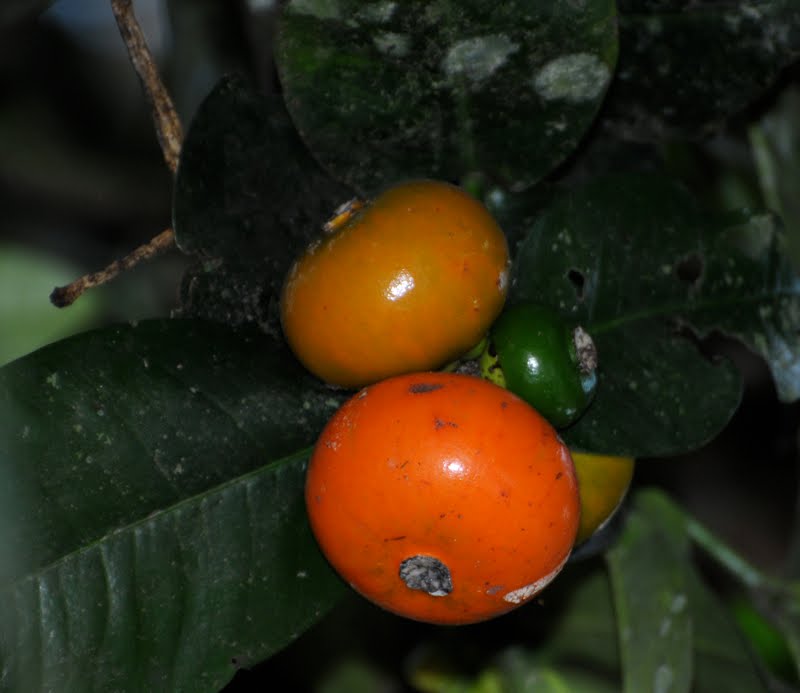
...next to a fruiting tree that carried what, as far as I can tell, is some sort of mangosteen relative -- at least, the fruits looked, inside and out, exactly like mangosteens (Garcinia mangostana), the most delicately delicious of fruits, except for their colour and slightly more astringent taste. A local orang asli told me that they were kecupu (Garcinia prainiana, also known as cherapu or button mangosteen), Kecupu trees were once once popular, but are apparently rarely grown today. Certainly the kecupu is far less well-known than its purple relative, which appears to be conquering the world.
The orchard proved to be a surprisingly lively spot for birds. This was a lifer for me, a Tiger Shrike (Lanius tigrinus). Tiger Shrikes are common winter visitors in West Malaysia, and I suspect I was just in time to see this one before its departure for its breeding grounds in eastern Asia.
Here is one of a group of Scaly-breasted Munias (Lonchura punctulata) we found by the trailside, feeding on tiny seeds of grass and sedge.
This delightfully pointy-headed creature is a female Grey-and-buff Woodpecker (Hemicircus concretus). She acted more like a nuthatch or a tit than in the manner we northerners have come to expect from woodpeckers. The two woodpeckers in the genus Hemicircus may, in fact, represent an early stage in the evolution of typical woodpecker behaviour. A recent genetic study has shown that Hemicircus is the sister-group to all other woodpeckers except the wrynecks and piculets, which lack the stiffened tail-feathers and tree-climbing adaptations of the rest of the family. In other words, this little bird may represent the first evolutionary stage in the evolution of a "true" woodpecker.
Here's something I never expected to see -and a tribute to the spotting skills of my companions!
This image, taken through a telescope, shows one of the most unusual breeding adaptations in birds. The lump between the legs of this Grey-rumped Treeswift (Hemiprocne longipennis) is its nest - one of the smallest in the avian world, so tiny that the bird must straddle it to brood its young. It is not even big enough to completely contain the single egg; instead, the egg is actually glued to the nest structure, perhaps deliberately but perhaps simply by adhering to the drying saliva that is the bird's main construction material.
The Handbook of the Birds of the World describes the Grey-rumped Treeswift's nest as "typically a half-saucer of hardened saliva incorporating small scraps of moss, bark flakes and body feathers, c. 36x24 mm, maximum outside depth 12 mm, built out as a bracket 5-30 m up on a thin, exposed twig." Why such a tiny, exposed structure? Perhaps to take advantage of the thinnest possible twigs, flexible supports that can instantly telegraph the slightest move by a prospective nest raider to the sitting parent.
This tattered but still beautiful butterfly is a female Malaysian Eggfly (Hypolimnas anomala). Eggflies are well-known mimics of other butterfly species. This one appears to be copying the crows (Euploea), members of the same family, Danaiidae, as the most famous butterfly to serve as a distasteful model,the monarch (Danaus plexippus). Usually only the female engages in mimicry, presumably because female butterflies select their mates and it is more important for a male to be recognizable to a prospective partner than to avoid a potential predator.
The orchard's trees were home to lizards as well as to birds. Here a Green Crested Lizard (Bronchocela cristatella) checks us out from a safe vantage point...
While on a nearby trunk a remarkable creature, a Common Gliding Lizard (Draco sumatranus), one of the genuine "flying dragons", signals his otherwise well-camouflaged presence with his bright yellow gular pouch. On to the forest at Perdek, which turned out to be surprisingly busy. A bevy of photographers from Singapore had the burrow of an Oriental Dwarf Kingfisher (Ceyx erithacus) pinned down under a barrage of telephoto lenses, much to the disgust of my birding friends, while a gaggle of buses disgorged a troop of Malay schoolchildren on a field trip. I was glad to see the kids - many teachers in Malaysia are unwilling to take their charges into the forest for fear of snakes, leeches and other creatures whose mere presence among the children might cause trouble with parents.
Letting children see the beauties of their own natural heritage, though, is never a bad thing.
Anyway, the visitors didn't seem to deter the birds. This would have been a pretty good shot of a Raffles's Malkoha (Rhinortha chlorophaea), a non-parasitic member of the cuckoo family, if that twig hadn't gotten in the way. Oh, well... The bird, by the way -- like the world's largest flower, Malaysia's most spectacular butterfly, and a famous hotel -- bears the name of Sir Stamford Raffles (1781-1826), the somewhat ill-starred founder of Singapore, who first described it in 1822.
This may look like some sort of warbler, but it is actually a Plain Sunbird (Anthreptes simplex), perhaps the least colourful member of its family. The pink bill marks it as a juvenile.I am not sure about the identity of the purple fruits that appear to have its attention.
And here is a bird that is anything but plain, a male Black-naped Monarch (Hypothymis azurea) on its nest. It is perhaps a bit unusual to see such a brilliantly-coloured bird taking its turn with nesting duties, especially when the nest is so open to view.
As the day became hotter the birds grew still, yielding the stage to the insects. Dragonflies like this Orthetrum chrysis perched in patches of sunlight.
This is Crocothemis servilia, an even redder species than the last. [Correction July 2017: actually Orthetrum testaceum
An animated bit of fluff crossing the forest floor -- the nymph of a flatid planthopper, covered with waxy filaments that serve it both as a disguise and as a sort of armour. A bird that pecks at it may get no more than a beakful of wax for its trouble (though strangely enough flatid nymphs are apparently a delicacy in some parts of Thailand).
A forest bee, perhaps a Giant Honeybee Apis dorsalis. What is it finding here? Butterflies congregate on the forest floor seeking mineral salts; perhaps the bee was doing the same.
Butterflies we found in plenty. This is a Malay Yeoman (Cirrichlora emalea), distinguishable from its near relatives by the straight-sided light bar on the underside of the hindwing, visible in the lower photograph.
The butterfly on the right of this photograph is a Lesser Jay (Graphium evemon), another species difficult to identify for certain without seeing the underside. The otherwise similar Common Jay (G. doson) has an extra red spot on the costal bar, the dark stripe at the leading edge of the hindwing.
By far the most numerous of the forest floor butterflies were the so-called albatrosses of the genus Appias. Why these delicate members of the sulphur family should bear the same name as Coleridge's giant seabirds I have no idea, unless the dark-tipped white wings of some species brought the plumage of an albatross (or, for that matter, a gannet or gull) to mind. Anyway, most of these are Chocolate Albatrosses (A. lyncida vasava).
The other species present, the beautiful Orange Albatross (Appias nero figulina), would be hard put to bring to mind a seabird of any description!
All told, it was a highly productive and enjoyable morning. Eileen, Carol and Seng certainly deserved their celebratory cups of coffee afterwards....
And I even managed to snap a final bird, a House Swallow (Hirundo tahitica), outside the kopitiam before we headed, at last, back to Kuala Lumpur.
As usual, eager readers of this blog (assuming such creatures exist) are having to wait an unconscionably long time for its author to catch up with himself. I'm already long home after four months in Asia, not to mention subsequent trips to the UK and Jamaica, and I am still trying to write up events that took place before I even reached Sarawak, my main destination. Oh, well, that's what comes of leading a more or less eventful life, I suppose. In my own defense I may say that I have been up to my ears completing writing projects on bird protection laws in the US (for the Animal Welfare Institute) and on the biology of the Cardinal family (for the Handbook of the Birds of the World), and blog writing has had to assume a very low profile.
Anyway, on my return from Fraser's Hill Seng and Carol took Eileen and I to Genting Highlands, an area I had previously avoided because I thought it had nothing more to offer than hideous condo blocks and a gambling casino. Well, it turns out that this entirely depends on where you go. Ignore the casino, head up the bumpy road to the weather station, and things change very rapidly indeed.
For one thing, the view improves, especially without all those buildings in the way!
Genting Highlands are just north of Kuala Lumpur, and some of the views from the top give splendid views of the sprawling city below. Genting is slightly higher than Fraser's Hill, and in the early morning it is cool enough to warrant a bit of warm clothing -- a good sign that you are not in an ordinary corner of Malaysia....
The weather station is high enough to hold a few birds that are hard to find at Fraser's Hill (such as Red-tailed Minla)....
Though photographing in the area can be risky! (Don't turn me in, gentle readers....)
Here's Eileen, waiting for me to finish waiting for a singing Lesser Shortwing that never appeared. Eileen has yet to grasp the fascination of staring for what seems like vast stretches of time into a featureless clump of bushes waiting for some obscure feathered creature to show itself, but she's a good sport.
Mosses can be impressive in Malaysia, especially at higher elevations where moss diversity increases; the largest moss in the world grows on Mount Kinabalu in Sabah. This isn't it, of course.
The subject of these photos is not a moss, but a clubmoss -- an entirely different, and vascular, plant. There are 32 species in Malaysia. This one is probably staghorn clubmoss (Lycopodiella cernua), a species with an almost worldwide distribution. Nothing frames a mountain landscape better than a spray of tree ferns. This one is probably Cyathea contaminans.
Ferns were everywhere along the roadside, and I only wish I were enough of a botanist to put names to them - especially to these gorgeous cinnamon-bronze fiddleheads. I'll do my best here with the aid of the photographs in Ferns of Malaysia in Colour, by A.G. Piggott (Tropical Press, 1988), but don't quote me.
This appears to be a species of Gleichenia, a group of ferns usually found scrambling along the edge of high mountain forests (as here). I think this is Gleichenia vulcanica.
I have no idea what these two ferns might be, but I am open for suggestions!
I'm not sure what this strange little fern is, with its three-lobed leaves and swollen black stems. it might be a Davallia of some sort (but they are supposed to be in the lowlands). Any fern experts reading this?
I think, in fact, that I am just going to give up on the rest of these – I have tried several times to figure out what they might be, but my pteridophyte smarts are not up to the task – please enjoy the photographs anyway.
The road ran parallel to a steep bank covered with all sorts of interesting plants that, once again, I couldn't identify – so I had better leave it at that or I will still be trying to finish this blog entry well past the first anniversary of my trip!
Now this I can identify, at least to genus. It's a Begonia. There are 52 native species of Begonia in Peninsular Malaysia, and there is even an excellent book about them that I don't have. Well, this is one of the 52. I wish it were Begonia alpina, a species found nowhere in the world but Genting Highlands, but based on photos of that species in the Flora of Peninsular Malaysia collection I'm afraid it isn't.
More plants I can't identify:one is a palm, and the other, well, isn't.
Among my favourite plants - and surely among the world's most striking and unusual - are the carnivorous Asiatic pitcher plants (Nepenthaceae). They reach their peak in Borneo, but I was glad to see this peninsular representative scrambling up a tree on the roadside. There are three species of Nepenthes at Genting; this one is probably N. sanguinea.
Nepenthes has two kinds of pitchers on each plant - rather squat basal pitchers like these, and the elongate, graceful upper pitchers you can see in my earlier photo. The two pitchers may even attract different types of prey, though perhaps not in this species.
On to the animal kingdom, and, in particular, its butterfly branch. This ground-loving species is a common three ring (Ypthima pandocus corticaria), described on one web site as the "Cinderella of butterflies".
This is probably a common grass yellow (Eurema hecabe contubernalis), the most widespread member of its genus in Malaysia and Singapore, but it could be a close relative. Species in this genus are almost identical to each other, and consequently very difficult to identify.
Finally, another common open-country species, the Indian cabbage white (Pieris canidia).
Here's Eileen getting down to ground level!
That's where you find local fauna, like this land snail.Malaysia has an unusually large number of gilled land snails (Prosobranchia), but the eyes on the tip, rather than base, of the tentacles suggest that this is one of the Pulmonata, the land snails with lungs that are by far the largest group of these animals you will find out of the water. Land snails are not usually trumpeted as tourist attractions, but here is a glowing report by one traveler who came here specifically with these humble creatures in mind. I have no idea what this little fellow is, but it seems that limestone hill country in Malaysia has been a mecca for snail hunters for many decades.
Below Genting lies the Awana Resort, and nearby is a road through lower-level forest. By the time we got there the birds were pretty quiet, but that doesn't mean the forest was silent. Instead, it rang with one of the most remarkable sounds I have ever heard - the hooting cries of a family of Siamang (Symphalangus syndactylus), the largest gibbon in the world.
We were enormously lucky; the Siamangs were not only audible but visible, and close to the road. They were a family of four, two adults and two young, and we watched and listened to them for some time as they sang and played in the treetops. Here is the male, with one of his young, inflating his throat sac in song.
And here is a video of the Siamangs in performance. I won't claim any credit for my skills as a cinematographer, but perhaps this will give you an idea of why our encounter with the Siamangs ranks as one of my great wildlife experiences - and all within range of a resort and a casino! Go figure.... Anyway, enjoy this Symphony for Siamangs.

 On April 11, for my last bit of birding in West Malaysia, Carol, Seng, Eileen Chiang and Lim Aun Tiah took me to two sites in Selangor not far from Kuala Lumpur: an orchard near Sungai Lepoh and a patch of forest near Perdek.
 At the orchard we met some other local birders and took a wee breakfast break...
 ...next to a fruiting tree that carried what, as far as I can tell, is some sort of mangosteen relative -- at least, the fruits looked, inside and out, exactly like mangosteens (Garcinia mangostana), the most delicately delicious of fruits, except for their colour and slightly more astringent taste. A local orang asli told me that they were kecupu (Garcinia prainiana, also known as cherapu or button mangosteen), Kecupu trees were once once popular, but are apparently rarely grown today. Certainly the kecupu is far less well-known than its purple relative, which appears to be conquering the world.
 The orchard proved to be a surprisingly lively spot for birds. This was a lifer for me, a Tiger Shrike (Lanius tigrinus). Tiger Shrikes are common winter visitors in West Malaysia, and I suspect I was just in time to see this one before its departure for its breeding grounds in eastern Asia.
 Here is one of a group of Scaly-breasted Munias (Lonchura punctulata) we found by the trailside, feeding on tiny seeds of grass and sedge.
 This delightfully pointy-headed creature is a female Grey-and-buff Woodpecker (Hemicircus concretus). She acted more like a nuthatch or a tit than in the manner we northerners have come to expect from woodpeckers. The two woodpeckers in the genus Hemicircus may, in fact, represent an early stage in the evolution of typical woodpecker behaviour. A recent genetic study has shown that Hemicircus is the sister-group to all other woodpeckers except the wrynecks and piculets, which lack the stiffened tail-feathers and tree-climbing adaptations of the rest of the family. In other words, this little bird may represent the first evolutionary stage in the evolution of a "true" woodpecker.
 Here's something I never expected to see -and a tribute to the spotting skills of my companions!
 This tattered but still beautiful butterfly is a female Malaysian Eggfly (Hypolimnas anomala). Eggflies are well-known mimics of other butterfly species. This one appears to be copying the crows (Euploea), members of the same family, Danaiidae, as the most famous butterfly to serve as a distasteful model,the monarch (Danaus plexippus). Usually only the female engages in mimicry, presumably because female butterflies select their mates and it is more important for a male to be recognizable to a prospective partner than to avoid a potential predator.
 The orchard's trees were home to lizards as well as to birds. Here a Green Crested Lizard (Bronchocela cristatella) checks us out from a safe vantage point...
 While on a nearby trunk a remarkable creature, a Common Gliding Lizard (Draco sumatranus), one of the genuine "flying dragons", signals his otherwise well-camouflaged presence with his bright yellow gular pouch.
 On to the forest at Perdek, which turned out to be surprisingly busy. A bevy of photographers from Singapore had the burrow of an Oriental Dwarf Kingfisher (Ceyx erithacus) pinned down under a barrage of telephoto lenses, much to the disgust of my birding friends, while a gaggle of buses disgorged a troop of Malay schoolchildren on a field trip. I was glad to see the kids - many teachers in Malaysia are unwilling to take their charges into the forest for fear of snakes, leeches and other creatures whose mere presence among the children might cause trouble with parents.
 Letting children see the beauties of their own natural heritage, though, is never a bad thing.
 Anyway, the visitors didn't seem to deter the birds. This would have been a pretty good shot of a Raffles's Malkoha (Rhinortha chlorophaea), a non-parasitic member of the cuckoo family, if that twig hadn't gotten in the way. Oh, well... The bird, by the way -- like the world's largest flower, Malaysia's most spectacular butterfly, and a famous hotel -- bears the name of Sir Stamford Raffles (1781-1826), the somewhat ill-starred founder of Singapore, who first described it in 1822.
 This may look like some sort of warbler, but it is actually a Plain Sunbird (Anthreptes simplex), perhaps the least colourful member of its family. The pink bill marks it as a juvenile.I am not sure about the identity of the purple fruits that appear to have its attention.
 And here is a bird that is anything but plain, a male Black-naped Monarch (Hypothymis azurea) on its nest. It is perhaps a bit unusual to see such a brilliantly-coloured bird taking its turn with nesting duties, especially when the nest is so open to view.
 As the day became hotter the birds grew still, yielding the stage to the insects. Dragonflies like this Orthetrum chrysis perched in patches of sunlight.
 This is Crocothemis servilia, an even redder species than the last. [Correction July 2017: actually Orthetrum testaceum
 A forest bee, perhaps a Giant Honeybee Apis dorsalis. What is it finding here? Butterflies congregate on the forest floor seeking mineral salts; perhaps the bee was doing the same.


 All told, it was a highly productive and enjoyable morning. Eileen, Carol and Seng certainly deserved their celebratory cups of coffee afterwards....


