After our day at Jiuzhaigou - symbolized here with a drive-by look at Shuzheng, a Tibetan village near the park entrance - you could say that our tour, literally, went downhill. You wouldn't be quite correct. Yes, we returned to the lowlands (on October 19, 2014), but to do so we had to scale the Gonggangling Pass north of Songpan.
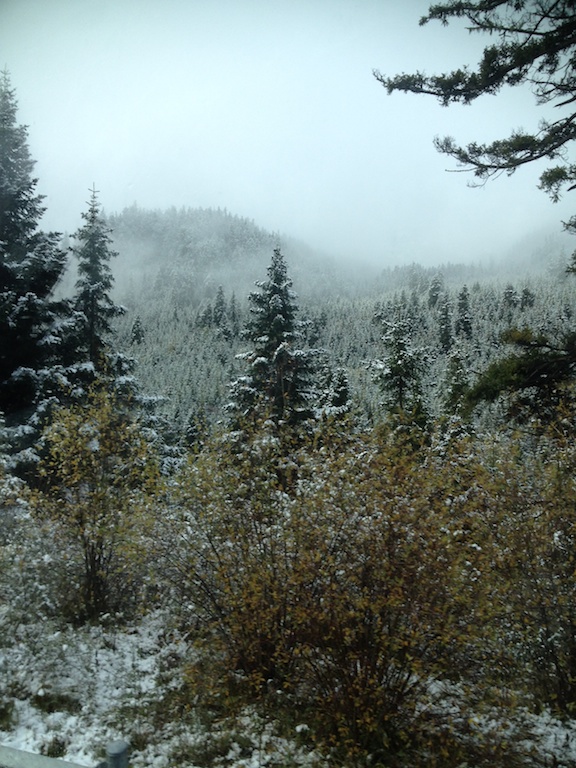
This time, though, it was daytime, and the pass was dusted with snow.
Cars full of tourists halted all along the road to gawp at what must be a rare sight for some of them. I hoped desperately that we would join them among the towering forest trees draped with strands of lichen - but there was no room for a fleet of buses.
Instead we pulled off in the middle of a stand of pint-sized (and presumably planted) spruce, our view of the mountains blocked by mist.
Oh, well, at least there was snow, and at least we were out of the bus.
While the others were snapping selfies among the snowfields, I poked around a bit to see what I could find near the roadside. I was hoping for birds, but by and large I had to settle for vegetation.
The vegetation was, as I have said, mostly spruce - I am not sure which species.
However, among the growing spruce trees were a number of broad-leaved plants, including this little flowering herb gamely trying to survive in the snow.
This appears to be a species of Cotoneaster. Again I do not know which one, but it does not appear to be the one specifically named for this region, C. songpanensis, which has more rounded leaves.
I was hoping for a few little birds - in spring the pass is home to such sought-after gems as the White-browed Tit-Warbler (Leptopoecile sophiae). Instead, a harsh, throaty 'cruk' announced the arrival of a pair of Northern Ravens (Corvus corax), and that was about it as far as birds were concerned.
After (reluctantly, in my case) reboarding the bus, we continued on over the pass itself (here's a sample of what I could have seen there - sigh..)...
....before turning southward again, to lower-elevation valleys decorated, in spots, with strings of Buddhist prayer flags.
Our next stop was not for sightseeing but for some government-mandated shopping. Before being herded into the (typically windowless, factory-sized) store, though, I noticed a pair of what were obviously vultures, circling high over the ridge above us. I saw them again at the shop door, and confirmed that they were, indeed, Himalayan Griffons (Gyps himalayensis). You can see the contrastingly pale underwing coverts in this distant photograph. Even our guide and the guardian of the shop door were interested.
Other than vultures, birds were not much in evidence - which is why I gave up searching for rarities long enough to focus on this charming group of Eurasian Tree Sparrows (Passer montanus) - common, quietly attractive and underrated birds, after all.
Raptors may be the birds to watch for in the Sichuan mountains in October. Our next stop was Songpan itself - an ancient city, now largely rebuilt a tourist market. (though the gates are original)..
...and when I decided to scan the mountain tops instead of looking at the town, I found a kettle of some hundred or more buzzards following the ridges southward.
They were much too far away to either photograph or identify - as was a large brownish falcon accompanying them - but an eagle that dipped below the ridge top displayed enough pattern to give me a name. It was almost blackish, with a white blaze on each wing and an even more startling white tail base. It must have been an immature Golden Eagle (Aquila chrysaetos).
On we drove, back to the warm, flat lowlands around Chengdu with, for most of our trip, even less to interest a naturalist along the way (at least from the window of a bus). At a refueling stop, though, I did have an encounter with an Asian Comma (Polygonia c-aureum), an Oriental representative of a group of butterflies found all across the temperate northern hemisphere.
I also came across a White-browed Laughingthrush (Garrulax sannio), here demonstrating its adaptation to urban life by perching on an automobile mirror.
Instead of stopping in Chengdu, we continued south to the town of Leshan, home to one of Sichuan's greatest man-made wonders. This is the Leshan Giant Buddha, The largest statue of Buddha in the world and, apparently, the largest pre-modern statue of any kind in existence. And for fans of Anthony Bourdain's television show Parts Unknown, yes, this is the place where he treated his traveling companion to a dish of barbecued bunny heads.
The Buddha overlooks the confluence of three rivers, and a rapid-fire bus tour like ours didn't give us time to stop at the statue itself. Instead we were treated to a cruise past it along the cliff-lined waters.
as we were not in sight of the statue the whole time, I turned my attention to the water birds along the river. Here, for example, is a roosting flock of Great Cormorants (Phalacrocorax carbo) with a few Grey Herons (Ardea cinerea) scattered amongst them.
A few solitary Grey Herons watched for fish from the rocks at the water's edge....
... and our boat was accompanied along our way by small numbers of Black-headed Gulls (Chroicocephalus ridibundus).
The Buddha itself (actually a statue of Maitreya rather than Buddha), once we neared it, revealed itself as a remarkable structure - less a statue than a carving directly from the cliff, with the hair and ears added later. Its statistics are astonishing: built over 90 years between 713 and 803 CE, it is, according to this web site, "71 meters (about 233 feet) high, and has 8.3-meter-long (about 27 feet) fingers. The 9-meter-wide (about 30 feet) instep is big enough for one hundred people to sit on and the 24-meter-wide (about 79 feet) shoulder is large enough to be a basketball playground." Needless to say, it was hard for us to appreciate its scale from a boat, but it was certainly something to see.
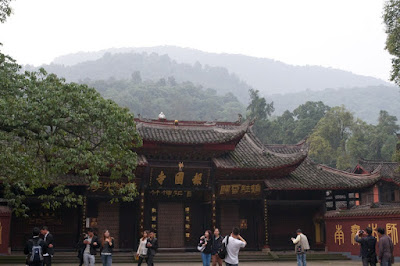
A short drive from Leshan brought us to our last (and for me, most frustrating) stop of the day. Mount Emei (or Emei Shan) is one of the most iconic places in China, both culturally and ecologically. It rises to more than 3,000 metres, with famous temple complexes at the top and bottom. It is equally famous as a must-see destination for birders. Two of its birds, the Emei Shan Liocichla (Liocichla omeiensis) and Emei Leaf Warbler (Phylloscopus emeiensis) are named for the mountain. I could easily have spent a day or more there. Instead, we were given no more than a brief late-afternoon stop at the foot.
I did have enough time to make a quick dash to the tree- and bamboo-lined access road, but it was already too late in the day for the local birdlife to put in an appearance.
I did, however, find one example of the mountain's animal life. This is a Pallas's Squirrel (Callosciurus erythraeus), a widespread species found from China to Peninsular Malaysia (plus Japan, where it has been introduced). I had met it before in a city park in Taipei, but it was nice to find it here.
Mind you, as night fell and the lights came up on the lower temple, even a frustrated birder had to admit that this was a place worth seeing - however briefly!
The next stop on our day tour (October 18, 2014) of Jiuzhaigou National Park, Sichuan, Five Flower Lake, still boasted crystal clear waters of a shade of aquamarine that had to be seen to be believed.
Unfortunately, this lake, in the heart of the area devastated by the August 2017 earthquake, was severely damaged and is no longer accessible.
These photos are a memorial to a beauty that was.
The deep blue waters of the lake were crisscrossed by the moss-covered trunks of fallen trees, creating patterns that should have (and for all I know, perhaps have) inspired generations of textile weavers.
A White-throated Dipper (Cinclus cinclus) splashed into the water near the viewing platform, searching for insect larvae beneath the surface.
This is the same species as the Dipper of England; it ranges across Eurasia, its various races differing in the amount of white on the breast (some birds lack it altogether, creating an identification problem where the species overlaps with the purely Asian Brown Dipper (Cinclus pallasii).
Autumn foliage colours are richest where the diversity of maples is highest - as it is in Eastern Asia, and eastern North America. Maples, unlike most other deciduous trees, do not simply lose their chlorophyll to display whatever pigments lie beneath. Instead, they pump new pigments - anthocyanins - into their leaves in autumn as part of boosting their sugar supply. The results are the rich oranges, reds and even purples that give maple trees their variety of autumn colour.
So it was at Jiuzhaigou, where there are a number species of maples, including this one (and I am not sure which one this is).
After a lunch break at the (now nearly demolished) visitor centre, we spent the remainder of our day at Jiuzhaigou exploring the westernmost of the two roads leading into the valleys in the north of the park.
This road ends at Long Lake, and a truly spectacular view of the mountains in the distance.
While my companions took pictures around the lake...
... I headed off into a nearby patch of brush in the hope of turning up at least one of the park's bird specialties. To my very great delight, I was successful. A party of tame and colourful Elliot's Laughingthrushes (Trochalopteron, or Garrulax, elliotii), undoubtedly the bird of the day, explored the undergrowth almost at my feet.
Mainland China, of course, is particularly rich in laughingthrushes, with some forty different species. Five are found nowhere else. Elliot's, confined to the eastern end of the Himalayan chain, is not one of them, but it comes pretty close (its range just extends over the border into northeastern India). This was my best chance of seeing it - and besides, what a gorgeous creature it is!
Laughingthrushes aside, I was torn between gazing up at the mountain peaks...
...and examining the trees and shrubs around me. One of the more attractive was Sorbus koehneana, variously called Chinese White-fruited Rowan or Koehne Mountain Ash. In North America we are used to trees of this genus being adorned with clusters of red orange berries, but the berries of a number of Asian species are white. This one is native to central China, but it is attractive enough to have been planted in gardens elsewhere.
From Long Lake we retraced our steps down the mountain, joining the crowds heading for one of the park's most popular attractions.
This is the Jade or Five Coloured Pool, so called because you can see five distinctive shades of blue in its crystalline waters. I hope that it still looks like this after the earthquake.
It is small but spectacular - no wonder the Chinese once believed that a goddess washed her hair in its waters.
Its colours, so the legend went, came from the rouge washed from the goddess's face. In fact they are the result of a combination of travertine sediments and algal growth covering the uneven surface of the lake bed.
This was pretty much our last stop at Jiuzhaigou. I'm glad to have seen it in its pristine state - and I am glad to hear that, in May 2018, the park will reopen its gates.