By November 18, 2014, my time in Sarawak was drawing to a close. I still had time for a last few excursions, sometimes with my grandson Ryan and sometimes when Ryan was in school.
Here are a few common dragonflies, from a brief trip to a grassy area near Kampung Bako; nothing unusual, but as I was about to leave Malaysia for some time I was glad to see them again.
The genus Neurothemis can be extremely frustrating. Neurothemis dragonflies are seemingly everywhere in open country in Sarawak - the ultimate ditch dragonfly, as it were. Finding them is easy; identifying them, though, is another matter. Of the three common species, two - Neurothemis fluctuans and Neurothemis ramburii - are both variable very similar in appearance. Size aside, telling which is which can be something of a guessing game.
I'm not saying this just because I'm an amateur. According to two experts, Malte Seehausen and Rory Dow, "Members of the genus Neurothemis Brauer, 1867 are difficult to identify to species due to the highly variable wing maculation of males and the polymorphism of females." So there.
Anyway, I think that the dragonfly in these photos is a male N. ramburii because of the long, rectangular space at the base of the wings (the cubit-anal space). N. fluctuans, is supposed to have two or three veins crossing this space. However, as Seehausen and Dow note, ramburii is a highly variable species, and I could be wrong.
This male Neurothemis terminata is a lot easier to place, because the hyaline (or clear) area at the tip of the hindwing is cut off squarely rather than tapering back towards the body at its rear edge, as it does in the other two species.
Neurothemis aside, probably the commonest "ditch dragonfly" in Sarawak is Orthetrum sabina, a very wide-ranging insect indeed, ranging from southeastern Europe and North Africa to Australia, Micronesia and Japan.
Another puzzler (at least to me) is Orthetrum glaucum. This, too, is a variable species, with the males differing in the extent and intensity of blue on the abdomen depending on the reach of the powdery covering, or pruinosity, covering it (if the pruinosity is rubbed off what is left is simply a black exoskeleton).
Some males, like this one, can be very light indeed, with strongly blue eyes. In West Malaysia I would have put this down as a related species, Orthetrum luzonicum, but luzonicum is not supposed to occur in Borneo, so glaucum it must be.
Orthetrums come in a variety of designer colours, including red. This one, with an extensively red-orange thorax, is presumably Orthetrum testaceum.
Finally, just to show that I can look at an insect that isn't a dragonfly, here is a handsome wasp: the Lesser banded hornet (Vespa affinis). This is not an animal to be taken lightly; its sting has caused human fatalities.
On Sunday, November 16, 2014, I joined Vincent Wong and his wife for a brief morning birding trip to Kubah National Park. It proved to be a less than bird-laden morning, but as always there are lots of other things to see at Kubah.
A walk up the entrance road will always be enlivened by butterflies of various species feeding at the roadside plants. A stranger to the tropics, though, might well be surprised to find that most of the butterflies you can see here are comparatively small and, as often as not, patterned mostly in shades of brown. Skippers in particular can be rather dull-coloured, though the Bright Red Velvet Bob (Korithaialos sindu) boasts an unusual splash of colour (Borneo lacks the truly brilliant skippers that enliven the tropics in Latin America).
Among the commonest, and plainest, of the roadside butterflies are the members of the genus Ypthima. Thay can be difficult to identify, but I am reasonably confident that this one is a Common Three-Ring (Yphthima pandocus).
Like Yphthima, the genus Eurema - the grass yellows - contains a number of very similar, small butterflies that one frequently finds low in roadside vegetation.
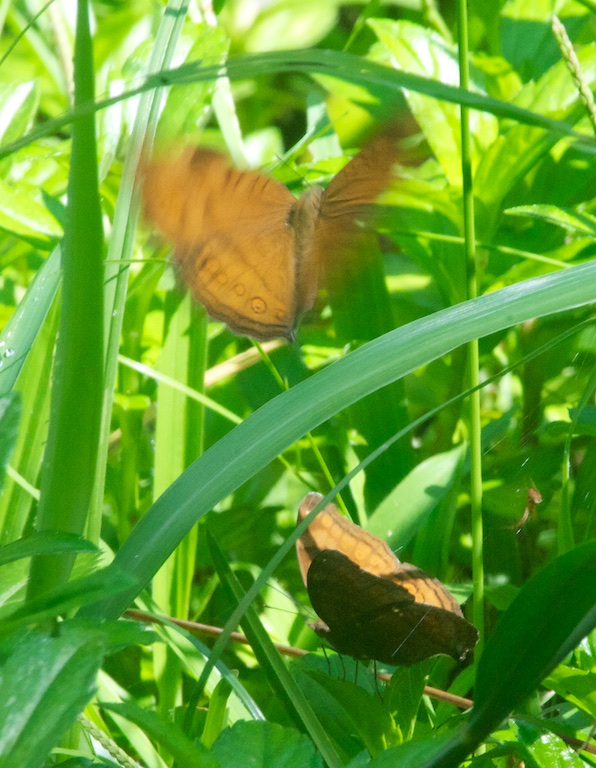
Another basically brown butterfly, with its own pattern of eyespots, is the Brown Pansy (Junonia hedonia). It is one of the plainer members of its genus.
The sexes are pretty much alike, but this male seemed to have no difficulty in identifying a potential mate.
As in many butterflies, pheromones may play a part here.
A rather more striking denizen of the forest edge is the Yellow Glassy Tiger (Parantica aspasia). This butterfly is mimicked by both a related butterfly and a moth, but I believe this, indeed, a Yellow Glassy Tiger and not one of its imitators.
Getting a good photo of a Rustic (Cupha erymanthis) can be tricky; they can be both energetic and flighty.
Tanaecia is a genus of forest-floor butterflies that feed on fallen fruits and rarely, if ever, visit flowers. They can be difficult to identify without detailed examination of their genitalia, but this one may be T. orphne.
Open areas along the roadside may be spanned by the enormous webs of the Golden Orb Weaver (Nephila pilipes).
Dragonflies at Kubah tend to fall into two categories: open-country and edge species, like this Orthetrum chrysis, that you can find along the roadside, and “true” forest species that may bask in patches of sunshine beneath the trees but rarely emerge into larger open areas.
The shadows around the frog pond, for example, are almost always brightened by a glittering, golden-eyed male Cratilla metallica perched over the water, guarding its territory, but I rarely see this common forest species on the roadside edge only a few yards away.
I love the frog pond, whether by night or by day. You never know what you will see from the boardwalk that circles it - perhaps, for example, a Three-keeled Ground Skink (Mabuya rudis) stretched out in a patch of sunlight.
The frog pond often turns up the sighting of the day. In this case it was a lovely little mammal that I do not recall having seen before, the Three-striped Ground Squirrel (Lariscus insignis). This is supposed to be a "shy, nervous" species, and this one lived up to the description. I was only able to get this photo as it streaked off into the forest.
Even if there is little animal life around, Kubah can still delight with its range of plants. As usual, I cannot identify these (though the lower one may be a species of Macaranga, a widespread genus of forest edge trees), but they are lovely all the same.
November 2014 found Eileen in Singapore to help out with our grandson Royce, who was continuing his cancer treatment, while I went back to Kuching to do the same for his older brother Ryan. Part of my job was ferrying Ryan back and forth from school. That left me time, during school hours, for a bit of insect-hunting around town (specifically at Sama Jaya and the MJC Road, home to the Water Lily (Nymphaea sp) in this photo). Here are some of the results, taken on November 13, 2014.
Let's start with dragonflies. Photographing darners (Aeshnidae) during their daytime hunts can be a challenge (at least for me), because they seldom perch and catching them in mid-flight can be, to put it mildly, tricky. This is the closest I have come to getting a recognizable photo of the commonest open-country species around Kuching, the Pale-spotted or Lesser Green Emperor (Anax guttatus), though I frequently see it coursing over the flooded lawn near the parking lot at Sama Jaya.
Like the Aeshnidae, the family Gomphidae has many members in Borneo, but only one is likely to be seen flying around in open country in broad daylight. That is this one, Ictinogomphus decoratus. The other Ictinogomphus in Borneo, I. acutus, behaves similarly but is much rarer and more localized; according to Rory Dow, the expert on such matters, it is common at Maludam National Park, the only place I have seen and (rather badly) photographed it.
The rest of the dragonflies in this little gallery are members of the largest dragonfly family, the Libellulidae. We start with the smallest of the lot, the tiny Nannophya pygmaea. This is a male, defending his little patch of territory.
Not much larger and almost as brilliant: Brachygonia oculata, a skulker in dark corners (including, in Sama Jaya, around puddles at the base of fallen trees).
I believe this is a female parasol (Neurothemis), probably the abundant Neurothemis terminata, but I admit I have identifying some of these plain brown insects from photographs.
The male Rhodothemis rufa, the Common Redbolt, is probably the reddest of Sarawak's dragonflies; even its eyes have a reddish tinge.
Finally, here is the splendidly bronze-winged Rhyothemis obsolescens.
PS: For readers who share my fascination with dragonflies (and damselflies), I have set up a new blog that collects all of the photos of these insects that have been featured in A Wandering Naturalist (plus a few more besides) and displays them, family by family, with links to the blog entries where they first appear. It's called Orenstein's Odonata (I'm partial to alliteration), and you can find it here.
Moving on to butterflies, here is the large and spectacular Great Mormon (Papilio memnon), a truly startling insect.
Much less startling is this little skipper, probably a Spotted Grass Dart (Taractrocera ardonia) - recognizable, apparently, by the lack of the little thread-like projection, or apiculus, at the tip of the antenna, a feature of most other skippers.
The Great Eggfly (Hypolimnas bolina) must have one of the most unappetizing English names in the butterfly world. It presumably refers to the somewhat egg-shaped white patches on the male's hindwings (the females mimic butterflies of the genus Euploea), but this is a much more attractive insect than its name suggests. It is an extremely wide-ranging butterfly, found from Madagascar across southern Asia to Australia, New Zealand (where it is called the Blue Moon Butterfly, a much nicer name) and the South Pacific.
Ceruleans (Jamides spp.), common little butterflies in the blue and hairstreak family (Lycaenidae), are easy to see but difficult to identify. There are many very similar species, and in the absence of a thorough field guide to Bornean butterflies I do not know which one this is.
This is another lycaenid, but one I do not recall having seen before: the Purple Tit (Hypolycaena merguia).