Sunday, February 12, 2012

New Zealand: Boulders and Birds

On March 11, 2011, we drove down from the heights of Mount Cook to the South Island's east coast, where we stopped off for a look at a truly peculiar spot: the boulders of Koekohe Beach, near Moeraki.  A set of fifty or so giant rounded pebbles may seem like an odd sort of tourist attraction, but I have never seen anything quite like the Moeraki boulders anywhere else.

The boulders are essentially a set of giant 60-million-year old concretions - hollow balls of mud and sand cemented together with calcite - that formed in the mud of the seafloor during the Paleocene.  They may have taken 4-5 million years or more to reach their present size.

I won't repeat  the details of their history and geology (read about them in what appears to be one of the better Wikipedia articles).  They are not, in fact, unique to this beach - apparently there are smaller versions a lot closer to my own home, at Kettle Point, Ontario (a fact I should have known; Kettle Point is a famous raptor migration spot).  Nonetheless, they are certainly worth a look.

For one thing, of course, they are really large...  smaller ones appear to have been carted off as souvenirs, but the area is protected so don't try this now (even assuming you have a beach-worthy forklift to hand).

Also, they are truly weird.

The stones are slowly weathering, and a number have broken open - revealing a hollow Rubik's Cube interior that looks every bit as alien as the complete boulders.  This is, according to Wikipedia at least, the result of cracks within the concretion becoming filled with a calcite mortar marking off the separate sections, or septaria, within the boulder.

Some, like the one at right, have lost their mortar, and fallen almost completely into their component bits.

The smooth faces of the septaria provide gathering places for limpets.  Going by range, these are  Cellana strigilis redimiculum, the only one of the six endemic members of this widespread Indo-Pacific genus [Famiy Nacellidae] on the southeast coast of the South Island, here at almost the northern extremity of its range (C. strigilis ranges south to New Zealand's subantarctic islands; if you are interested in the details a thesis on the subject by Sharyn Goldstein is available online).

The outer surfaces of the boulders carry clusters of rock barnacles and Little Black Mussels (Xenostrobus pulex) where they are washed by the tide.

Around the boulders, and along the sandy beach leading to them, remains of marine life lay among the wrack. Strands of beach-washed kelp stretched out along the tide line...

...interspersed with tangled mats of other brown algae (the top photo is possibly bladder kelp (Macrocystis pyrifera) though I'm far from sure)...

...and dried bits of sponge (there may be over 1500 species of sponge in New Zealand, with some 95% of them endemic to the region).

Not someone's tires exploded on the beach, but the leathery fronds of bull kelp (perhaps Durvillaea antarctica).

Shells of various sorts littered the sand along the beach.  The large snail on the left appears to be Southern Cat's-Eye (Modella granulosa, Turbinidae), based on photographs on the excellent New Zealand Mollusca web site.  The name refers not to the shell but to its shiny operculum, the plate that closes in the living animal.

Over the course of its life this mussel, presumably a green-lipped mussel (Perna canaliculus), picked up some passengers.

A sort of cockle or venus clam - rather beachworn, so I'm not sure exactly what it is.

These attractive bivalves may be Common Pipi (Donax deltoides).

The shells on the beach attract oystercatchers, anxious to see if any of them still contain something edible, and gulls waiting to see if the oystercatchers have any luck.  Here a Red-billed Gull (Chroicocephalus scopulinus) eyes a Variable Oystercatcher (Haematopus unicolor) as it puts its can-opener of a bill to good use.

This oystercatcher is enjoying a bit more privacy.

Oystercatchers are beautiful things, especially to Canadian inlanders like me who almost never get to see them.
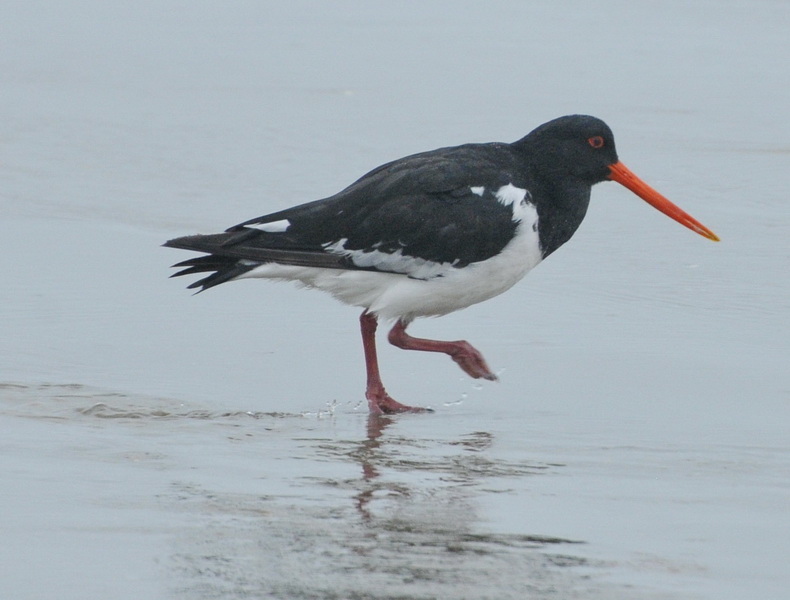
This is the other oystercatcher of mainland New Zealand, the South Island Pied (Haematopus finschii).  Its bill appears thinner than the Variable Oystercatcher's, but what difference does this make to the feeding preferences of the two species? 

For that question, I turned to a 1974 paper by Dr Allan Baker, curator of birds at the Royal Ontario Museum in Toronto (where I did my Master's thesis), a transplanted New Zealander and the world's leading authority on oystercatchers: Prey-specific feeding methods of New Zealand oystercatchers, Notornis 21: 219-233.  According to Allan, oystercatchers have specific techniques depending on which sort of mollusk they are trying to deal with, but in general Pieds concentrate on bivalves like clams and oysters while Variables are better-adapted to prying limpets and chitons from their rocky perches.  Obviously the Variable Oystercatchers at Moeraki, happily eating mussels, haven't read the paper (not fair; Allan of course notes a lot of overlap between the two species, but I couldn't resist).

Here are the two species in flight.

With the two oystercatchers I found all three species of New Zealand gull: the largest, the Kelp Gull (Larus dominicanus)...

...the ubiquitous Red-billed Gull...

...and the prettiest of the lot, the Black-billed Gull (Chroicocephalus bulleri), found on both islands but far commoner in the South.

Here are the Red-billed and Black-billed together, for comparison.... 

And here, joining them, is a White-fronted Tern (Sterna striata). 

And finally here is Eileen, demonstrating why she left most of the beach-walking to her heavier-set husband, who was far less likely to be blown out to sea in the process!

Saturday, February 11, 2012

New Zealand: Encounter with a Black Stilt

This freshwater marsh lying beneath the magnificent Mount Cook is more than a part of a splendid scene.  It is habitat for one of the rarest birds in the world.

I had long wanted to see a Black Stilt (Himantopus novaezelandiae), but I had assumed that accomplishing this would be a very difficult (and given this Critically Endangered bird's rarity, perhaps not very acceptable, except by appointment at a visitor's hide) task.  As of August 2011 (after my visit in March) there were only 170 adult birds (a lot better than the 23 to which the bird was reduced by 1981), the result of a careful conservation and captive breeding program.  Most of the places they survive in (or have been reintroduced to) are not easy to reach - and besides, most are around Twizel, a city we had already passed on our way to Mount Cook.

Judge of my surprise, at checking in to our accommodation below Mount Cook, to be told that the birds were waiting for me only about 100 yards down the road....

The result, I believe, of a recent reintroduction. Sure enough, once we walked down to the edge of the marsh a Black Stilt appeared almost immediately -- on the far side, of course.

I thought that was good enough, but I had reckoned without the bird.  It was obviously as interested in us as we were in it, and to our astonishment it took off and flew across the water almost directly to our feet.  I suspect that it was a captive-bred bird habituated to humans, and maybe hadn't seen one of us in a while.

Anyway, even in the fading dusk there could hardly have been a more ideal way to see such a rare creature:

Here is a bit of video:


And, to set the whole experience in context, here are a couple of views of Mount Cook in the setting sun.

Friday, February 10, 2012

New Zealand: Below Aoraki

Golly, I'm getting behind with this blog!  Apologies to any long-suffering readers that still look at this stuff...

On March 10 (2011!), before heading down to the east coast, we turned north to one of the South Island's most famous and magnificent sights: Aoraki, Mount Cook, the highest peak in New Zealand.  As this photo, taken from behind the black wall of a glacal moraine, shows, we were phenomenally lucky - the sun shone on the mountain, often obscured by cloud and mist, almost throughout our visit.

Of course the stunning scenery is the main reason most people visit Mount Cook, and there's a lot of it...

Not to mention a variety of mountain hikes.  We took a couple of the (very) easy ones.

One led to the clay-coloured waters of a glacial lake dotted with floating icebergs, calved from alpine glaciers like the ones in the lower photograph.


Its shore was bounded by centuries of glacial rubble, presumably washed down from the nearby moraine, supporting the occasional, oddly blue-green pond.

For those willing to tear their eyes away from the scenery, Mount Cook boasts an array of alpine plants.  Some - despite the lateness of the austral autumn season - were still in flower.  I am indebted to Hugh Wilson, author of a guide to the alpine flora of the mountain, for the names that follow (any mistakes are, of course, mine).

Most impressive were the dried spikes of golden spaniard (Aciphylla aurea), an unlikely-looking member of the carrot family (Apiaciae), their flowering period now finished.

These are the reddish leaves of scarlet snowberry (Gaultheria crassa), a plant I had seen earlier in Arthur's Pass.

Also strikingly rosy were the spikes of a willowherb (Epilobium melanocaulon), another member of a genus familiar from the northern hemisphere.

These are the flowers of New Zealand Bluebell (Wahlenbergia albomarginata), a  member of the Campanulaceae - the same family as the bluebells of England, but here they are autumn bloomers and, like so many of New Zealand's alpine wildflowers, white instead of blue (or very pale blue at best).

The dense, closely-packed growths of Raoulia glabra, a composite (Asteraceae), are a moderate alpine specialization compared with that of some of its close relatives, whose growth is packed into such a tight, mounded mass that they are known as "vegetable sheep".

Here's another, much more extreme species of Raoulia - a dense, moss-like mat, clinging to the ground in the face of the mountain winds.

By contrast, this really is a moss: woolly fringe-moss, Racomitrium lanuginosum.

Here, Raoulia (the flowering plant, above) meets Racomitrum (the moss, below) - as nice an example of botanical convergence as you could hope to see.

Not the world's largest amoeba, but a colony of lichen (Neofuscelia sp.).

The grass tree (Dracophyllum longifolium) is an exceedingly wide-ranging plant in New Zealand, found throughout the main isands from sea level to 1200 metres elevation.

A few more alpines: porcupine shrub (Melicytus alpinus), top; Piripiri (Acaena inermis), middle; and Hebe subalpina, bottom.

The tangled stems of matagouri (Discaria taumatou) once earned it the name "wild Irishman" - undoubtedly no longer politically correct for a variety of reasons.  Was this growth habit an attempt to discourage browsing moas?  Maybe - but for a negative opinion published as far back as 1905, see here.

Readers of this blog will know that I am fascinated by celery pines (Phyllocladus) and their leaflike, flattened branches.  Besides, I think Eileen looks very fetching next to this one, a mountain toatoa (P. alpinus).

Among the tussock grasses of the South Island there are tussock butterflies.  This one is a Common Tussock (Argyropenga antipodum), one of three New Zealand species.

An unspectacular bird except for its red eye and tinkling song: a Grey Warbler, Grey Gerygone or Riroriro (Gerygone igata).

And to finish, a considerably more striking species: a pair of Paradise Shelducks (Tadorna variegata), one of the more spectacular examples of sexual plumage difference in birds.  The female is the one with the white head.  

Paradise Ducks (as New Zealanders usually call them) are one of the few native birds that have benefited from European settlement, though some of the benefit is tough on individual birds as it is provided by hunters, who put out extra provisioning for their intended targets.  

Whatever you think of that, this has resulted (along with the increase in acreage devoted to pasture) has resulted in a lot more Paradise Ducks.  These two, poking around a National Park parking lot, obviously had nothing to worry about, and let us get satisfyingly close.