Sunday, February 19, 2012

New Zealand: Albatrosses and Mollymauks

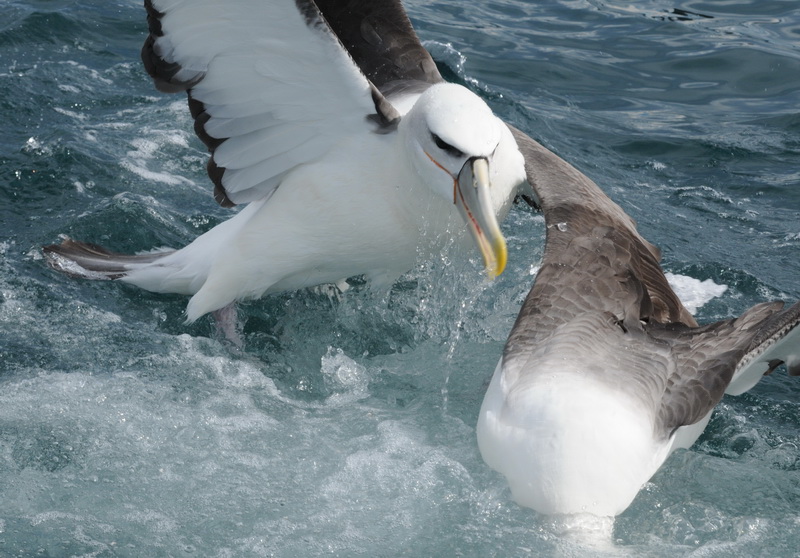
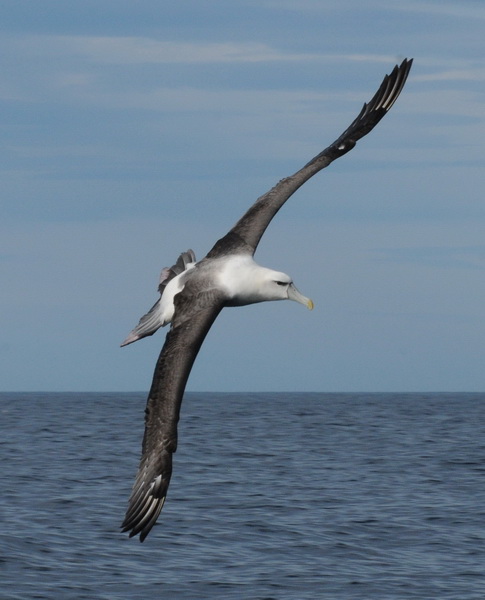
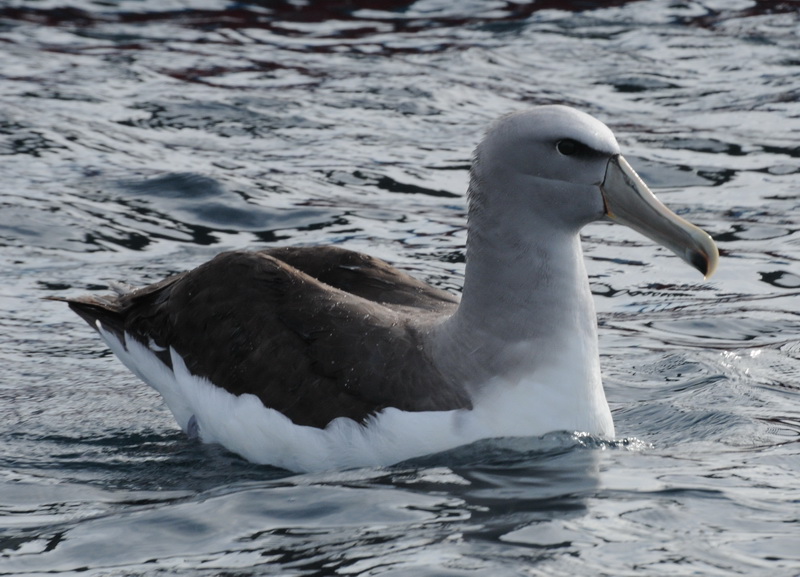
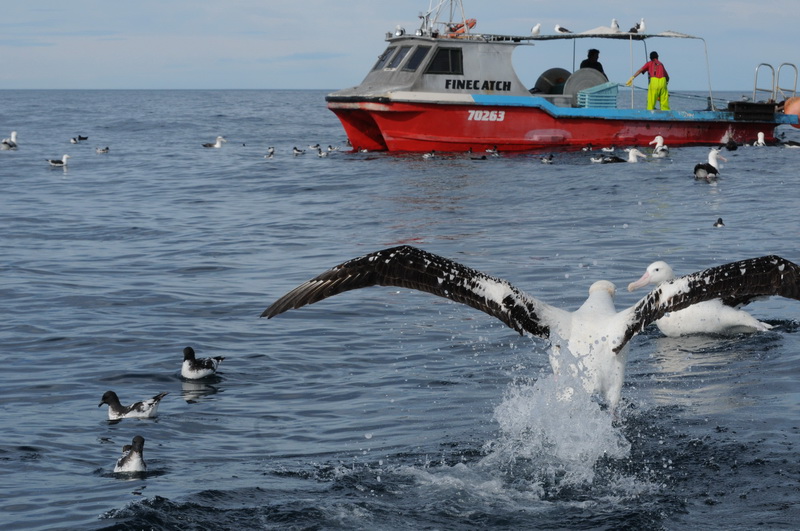
For my next two entries I want to give you a more detailed look at the birds saw off Kaikoura with Albatross Encounters (see my previous entry for the trip itself).  We'll start with the big boys: the albatrosses, including the smaller species colloquially known as mollymauks.  Here is a nice collection of them: from top, Wandering, Salvin's, White-capped and another Wanderer.  Salvin's and White-capped qualify as mollymauks.

For an overview of all the albatrosses, and indeed of seabirds in general, see the Ocean Wanderers website.

First up are the great albatrosses (Diomedea).  Sorting them out in New Zealand used to be easy: there were two species, the Wandering and the Royal, told apart by the absence or presence, respectively, of a black line along the cutting edge of the bill.

Albatross taxonomy, though, is in a state of serious flux, with many of the separate forms being raised to ful species status on molecular and other grounds.  The Wandering Albatross has been split into as many of five species, three of which show up around Kaikoura, and identifying them is very difficult - not least because Wanderers go through a number of plumage changes and immatures of one form may resemble adults of another.  The Royal has been split in two, and both species are found off Kaikoura.

That's a Northern Royal (Diomedea sanfordi) at left in the photo above, and some sort of Wanderer - perhaps a Wandering Albatross (D. exulans)? - to the right.

Let's start with the Wanderer, one of the most famous seabirds in the world.  Even if you can't judge size, the white back marks it as a Diomedea.

Now comes the hard part.  Which of the three newly-split species are we looking at?  The newest New Zealand Field Guide, by Julian Fitter and the late Don Merton, makes things a bit easier by "lumping" two of them, the Antipodean (D. antipodensis) and Gibson's (D. gibsoni), calling them all Antipodean Albatrosses.  They are less white than Wanderers, and this brown-capped, rather mottled bird is likely an Antipodean, but it is possibly an immature of one of the others.

The pure white head of this bird suggests the "true" Wandering or Snowy Albatross (the pink feathers over the ear apparently mark it a a male).

Perhaps these squabbling birds are Wanderers too.

What about the others?  The Wandering is the whitest of the lot; I never saw one with the largely white wings of an old bird.  Gibson's is whiter than the Antipodean, and adults lose the brown cap - so is this rather mottled bird a Gibson's?  It has a fair bit of black in the wing, as Gibson's is supposed to do.

And these?  They have at least some brown mottling, and more or less black on the wing - young Wanderers?  Older Gibson's?  I'd love to hear your opinions!

The Royals are a lot easier.  The crisp black and white of the Northern Royal makes it, to my mind, the most striking of the great albatrosses.

It is also the only one to breed on the main New Zealand islands.  On my first trip to New Zealand, in 1974, I was taken to see an enormous Northern Royal nestling - a downy chick the size of a swan - at the famous Taiaroa Head colony near Dunedin.

Until my Kaikoura pelagic, 37 years later, the Northern Royal was the only bird species on my life list that I had never seen out of the nest.

The Southern Royal Albatross (D. epomophora), the commoner of the two on our trip (with twice the global population, too), has more mottled wings and finely-barred scapulars, like a Wanderer.

It is the largest of all the albatrosses, but I can't say I was aware of the difference at sea.

On to the mollymawks.  The White-capped Albatross (Thalassarche steadi) is one product of a four-way split of what used to be called the Shy Albatross (T. cauta), largest of the mollymauk group.

I had seen "true" Shys (well, I think so) in my early pelagic birding days in Australia in the 1970s, but how you tell them from this bird at sea I'd be hesitant to say, though the Shy has a yellower bill.

As I mentioned in my previous post, the White-caps seemed to be particularly aggressive.

Salvin's Albatrosses (Thalassarche salvini), another member of the Shy complex, are much greyer birds than the White-capped.

The bill is greyish with a yellow racing stripe along the top and a black spot at the tip of the lower mandible.

On some birds (immatures, I think) the bill is less sharply patterned and the grey of the head and neck a little lighter.

Finally, the most colourful of the lot, the striking Buller's Albatross (Thalassarche bulleri).  The bill, striped above and below, is a dead giveaway.

There you have it - if you accept all the splits, that's up to eight species of albatross at close range in one two-hour boat trip (four, though, if you are old-fashioned taxonomically)!  New Zealand is the world centre of albatross breeding diversity, and Kaikoura may be the best place on the planet to see so many kinds so easily.

Saturday, February 18, 2012

New Zealand: Kaikoura Adventure

On March 16, 2011, Eileen and I, with our young friend Michelle Wong, drove north from Christchurch to the Kaikoura Peninsula, home of (in my opinion) one of New Zealand's most worthwhile tourist attractions.  Kaikoura sits along a portion of the South Island's east coast where the continental shelf drops away into the abyss only a short distance from shore.  Upwellings of cold water bring a wealth of food to the surface, and whales, fishes and seabirds flock to the area.  A short boat ride can take you to anything from a bevy of albatrosses to a pod of whales.

Eileen is not a boat person, so she and Michelle decided to stay on shore.  Left to my own devices, I elected to take the morning Albatross Encounter tour in search of seabirds.  Once I had bought my ticket, the three of headed down the coast to see the shoreline at dusk.

Here we found a variety of wildlife large and small on the exposed rocky shore.  This peculiar-looking object is a seaweed: a brown alga colourfully known as Neptune's Necklace (Hormosira banksii), common in the littoral zone in both New Zealand and Australia.  The inflated "beads" of the necklace are not floats, but water-filled vesicles that keep the plants from drying when the tide is out.

Limpets are common on the rocks.  The upper ones appear to be Cellana radians, cousins to the Cellana limpets I saw at Moeraki.  The lower one may be Cellana flava.  Or I could be wrong, of course.

No doubt whatever as to what this is: a young Southern or New Zealand Fur Seal (Arctocephalus forsteri), hauled up on the rocks and casting a nervous eye in my direction.

A Double-banded Plover or Banded Dotterel (Charadrius bicinctus), either a juvenile or an adult in non-breeding plumage, thinks (perhaps) about its upcoming migratory flight to Australia or New Caledonia.  Some birds stay in New Zealand, where they breed, all year.  Notice the faint second band below the obvious one.

It was getting almost too dark to see when I spotted this Little Penguin (Eudyptula minor) bobbing on the water just offshore.  Whether it would have come up onto the rocks had we not been around I don't know (Little Penguins usually head for their nesting burrows after dark).  

About 15 pairs of penguins breed on the peninsula, but their ranks are swelled after the breeding season by wintering birds, including White-flippered Penguins (E. m. albosignata, sometimes considered a separate species) from the Banks Peninsula.  I never saw the flippers on this bird, so I'm not sure if it is a White-flippered or simply an ordinary Little Blue.

Sunset found us still along the shore, but we soon headed back to town for the night - and for me to make final preparations for my adventure the next morning.

The trick to pelagic birding is a very simple one: hope for good weather, head to where the birds are, toss over some fish guts and hope for the best.  That about sums up the basis for Albatross Encounters.

I have been on pelagic trips off Australia, California, and Peru, but they were all full-day excursions far out into the ocean.  Because the upwellings that bring in the birds are so close to shore at Kaikoura, the Albatross Encounter trips are a mere two hours - but two hours of more intensely concentrated pelagic birding it would be hard to imagine.  In future entries we will look at the species in more detail, but I hope this one gives you at least the flavour of a most exciting morning.

Between our boat with its bag of chum and the fishing boats working nearby, we attracted literally hordes of birds.  It was hard to tell where to look first, though a Wandering Albatross (Diomedea exulans), with an attendant gang of Cape Petrels (Daption capense), makes a good place to start.

The organizers who call these trips "Albatross Encounters" aren't kidding.  Almost as soon as we lowered the chum over the side we were descended upon by squabbling scrums of these great birds, often nearly close enough to touch (not a good idea; the cutting edges of an abatross's bill are extremely sharp.  Here, Salvin's Albatrosses (Diomedea salvini) swim behind a juvenile Northern Giant Petrel (Macronectes halli).

Even larger birds: A northern Royal Albatross (Diomedea sanfordi) waits among the Cape Petrels while a Wanderer has a go at the chum bag.

The bigger birds, like this Wanderer. tend to hog the chum bag while the smaller Cape Petrels can only look on.

Giant Petrels are particularly aggressive.

These three Giant Petrels and a Wandering Albatross seem civil enough as they surround the chum...

...but things can rapidly get out of hand over a choice morsel.  Here, a White-capped Albatross (Diomedea cauta steadi) moves in on a Westland Petrel (Procellaria westlandica) and some Cape Petrels.

Still photos can't convey the noise and excitement.  Here's a few minutes of video to give you a better idea (with a dollop of Southern Fur Seal (Arctocephalus forsteri) thrown in at the end).

Tubenoses - albatrosses, petrels and the like - are the chief reasons to go on the Albatross Encounters trip, but they aren't the only things to see.  Here, a Kelp Gull (Larus dominicanus) perches on our boat.

This is a bird I did not expect to see: a Black-fronted Tern (Chlidonias albostriatus) in non-breeding plumage.  This is primarily a riverside bird, its inland breeding range almost entirely restricted to the eastern slope o the South Island.  I did not realize that it disperses to the ocean in the non-breeding season, but here it is. The global population is only about 5-10,000. It appears to be declining everywhere, and Birdlife classifies it as Endangered.

We finished our trip with a spin by a few coastal islets, where fur seals swam among the drifting kelp and cormorants sunned themselves on the rocks.

This Spotted Shag (Stictocarbo punctatus) is in non-breeding plumage, a shadow of its crisp breeding colours.

Here are some Southern Fur Seals, both on shore and at sea.

A birding compatriot of mine once told me that "The best bird of the day is a mammal".  This is not always true; but even the albatrosses were topped, for sheer excitement, by our final encounter with an enormous pod of some 300 Dusky Dolphins (Lagenorhynchus obscurus), stretched out in a long line parallel to the coast (After the trip we drove down the coast so Eileen and Michelle could watch them from shore).

Before long we were in their midst.  Duskies are common off Kaikoura; a 2004 study estimated that some 12,000 roamed off the peninsula.  They are attracted to boats, much to the delight of wildlife-watchers like me.

Most of all, Dusky Dolphins are wonderful and exuberant acrobats, repeatedly throwing themselves out of the water in a series of somersaults, backflips and other manouevres.  Are they simply having fun?  Showing off to the opposite sex?  We don't know. A book on the subject, summarizing what we know of Dusky Dolphin behaviour, can only ascribe their activity to heightened excitement in social situations, indicating "high levels of alertness and a 'party-like' atmosphere", and speculate that their leaps might provide "a 'massage-like' therapy for feeling good"!

Well, there you have it from the experts - the dolphins are pickin' up good vibrations.  Party on!