Friday, March 8, 2013

New Zealand: Wetland and Forest

 When you think of New Zealand (or, at least, when I do), your thoughts are likely to run to glacier-covered mountains, dense, dark forests or rocky coasts overlooking the sea. Freshwater wetlands are probably not the first thing that would come to mind. One of the things I discovered on our December 2011 trip around the North Island with our grandson Ryan is that not only does New Zealand have such places, they have attractions I wouldn't have suspected for a small child. It was during a rainy turn around the boardwalk at Pekapeka Wetland that Ryan looked up to me and said, happily, "Grandpa, I like being in New Zealand!"

Pekapeka, certainly, makes for a pleasant stop.  It is a restored wetland, operated by the Hawkes Bay Regional Council, 10 km south of Hastings (we stopped there en route from Mount Bruce to Napier).

The wetland boasts over 80 species of plants, both native and introduced.  This is (I believe) one of the native species, Harakeke or New Zealand Flax (Phormium tenax).

 New Zealand has a fascinating collection of endemic land snails. This, unfortunately, isn't one of them. It is, instead, an invader from Europe, the Brown Garden Snail (Cantareus aspersus), and its presence has raised concerns about its effects on native vegetation as well as on the snails that really belong on the islands.

After a bit of reluctance, Ryan got to touch the snail -- for him, one of the high points of our trip!

On our way out of Napier, we stopped for another wetland walk, this one along the Ahuriri Estuary Walkway on the edge of town.  Like Pekapeka, this area is of fairly recent origin - but this time the cause is natural.  Until 1931, this was part of a vast tidal lagoon.  The massive Hawkes Bay Earthquake in that year lifted the estuary by 2.7 metres, draining most of it.  The walkway circles what is left.  These striking sculptures, by local Maori artist Hugh Tareha, are pou whenua, wooden marking posts used to designate places of significance or tribal boundaries.  We didn't know that at the time, and found them rather puzzling!

Here we found another exotic invader: the Hottentot Fig (Carpobrotus edulis), a South African plant that has become a highly invasive pest in many parts of the world (however attractive it may be).

The Welcome Swallow (Hirundo neoxena) is another new arrival in New Zealand (it has bred in the islands only since 1958), but unlike the Garden Snail and the Hottentot Fig, it got here on its own.  

Out on the water, at some distance, Ryan and I found a few native water birds.  These little blobs represent our closest look at the endemic New Zealand Dabchick (Poliocephalus rufipectus), the smaller of New Zealand's two grebes.

This photo does scant justice to the attractive New Zealand Shoveler (Anas rhynchotis variegata), one of the handsomer ducks in the country (for proof see here).  It is considerably more strikingly marked than the only other subspecies, the Australian Shoveler (A. r. rhynchotis).

Ryan was most fascinated, though - as small boys would be - by the crabs.  Mud crabs (Helica crassa) and their burrows are abundant features of estuary life, and the crabs themselves have an ecological important role as environmental recycling units.  Anyway, Ryan thought they were pretty neat.

From Napier, we drove back across the North Island (once again, in the rain) to Hamilton and the first step on our journey back to Malaysia.  I convinced Eileen (and Ryan) to put up with a brief detour to the Pureora Forest Park west of Lake Taupo.  I was hoping to turn up one of the most interesting of New Zealand's forest birds, the Rifleman (Acanthisitta chloris), but between the rain and the time of day it was to no avail.  

Nonetheless, it gave Ryan and I a last brief taste of the rich and splendid temperate rainforests that once blanketed the island.

The most magnificent ornaments to the forest, to my eye, were the several species of tree ferns.  I think this one is a Wheki (Dicksonia squarrosa), but fern experts out there may feel differently.

Some more tree fern views: a fiddlehead, and a set of drooping fronds (which, on some species, remain as a sort of"skirt" under the living leaves).

Of course, a lot of the forest ferns were much smaller!

The humid forest floor was decorated with the minature parasols of umbrella moss (Hypnodendron spp.)...

...and lichens of various sorts.

My last New Zealand birds: Piwakawaka, the New Zealand Fantail (Rhipidura fuliginosa)...

....and the tamest of the tame, a North Island Robin (Petroica longipes), perhaps hopping out to check whether Ryan and I were merely humans, or perhaps a family group of moas stalking by, kicking up a few tasty insects as we passed.

Friday, January 18, 2013

New Zealand: Gulls on the Beach

First, an apology to my readers; I have been extremely swamped with a number of things, including a book manuscript due at the end of January.  I haven't forgotten about this blog, though, so stay (patiently) tuned!

From Mount Bruce we drove on to the east coast of the North Island (with one stop I'll describe in the next post) to the city of Napier, home (to Ryan's delight) of New Zealand's National Aquarium.  This posting, though, is set on a beach south of town, where Ryan was introduced to the delights of shell collecting and I had some close encounters with all three of New Zealand's gulls.

Our scene is a stretch of shingle, its tide-line marked with wave-tossed kelp.

A lone surf fisherman has strung a line from the shore, and from it dangle the severed heads of small sharks - presumably the remains of his catch.

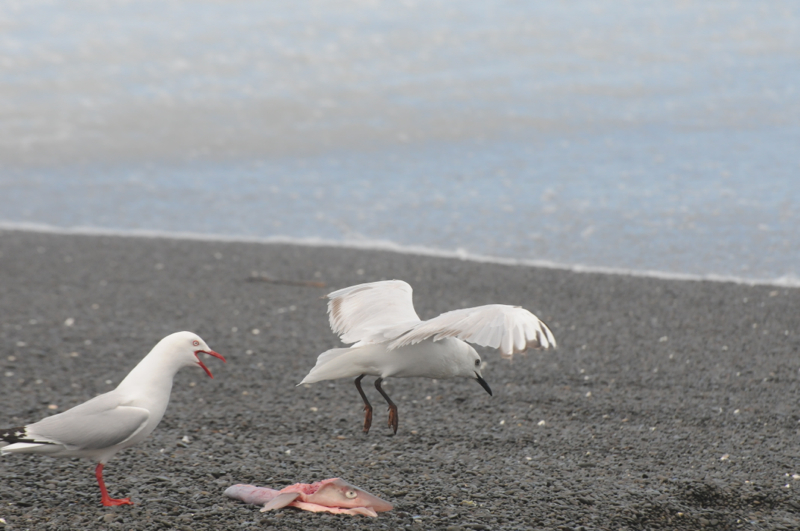
The offal has drawn in crowds of gulls, who pay little attention to us as they swarm in for an easy meal.  We've met these gulls before in these postings, during my first 2012 trip to New Zealand, so this time round I will pretty much let the pictures speak for themselves.


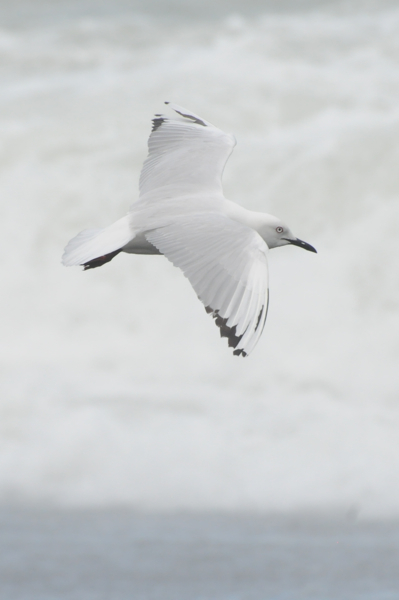
First up is my favourite, the elegant Black-billed Gull (Chroicocephalus bulleri), much the uncommonest species on the North Island (its stronghold is in the South).

As this species ages from juvenile to adult, it's Bill turns from flesh-colored, with a dark, too solid black and its eyes lightened from dark to a startling and rather ghostly white. These birds seem to be partway through the change: their bills are black, but their eyes have not fully lightened.

Notice the difference in eye colour between the bird in the foreground (and in the upper picture) and the presumably more fully mature one behind it.

By the time the bird is fully mature, it's iris is very pale indeed – and note the red fleshy ring around it. This seems to give the bird in the lower picture a real advantage as it tries to stare you down!

Black-billed Gulls are particularly graceful in flight. I hope these pictures show why I am so fond of these lovely birds.
The Black-bills are joined (and challenged) by their commoner, and rather stockier, cousin, the Red-billed Gull (Chroicocephalus scopulinus).
The Red-bills take their own turn at the dismembered shark heads.
Red-billed Gulls, close up and in flight...
...Challenged, in their turn, by the largest New Zealand gull, the Kelp Gull (Larus dominicanus).
More Kelp Gulls, adults and immatures, wheel over the surf or sit waiting on the beach nearby....
While Ryan looks for treasures in the beach wrack....

...and tosses pebbles into the sea.