Readers of this blog probably already know that my favourite spot for an outing in Sarawak is the Borneo Highlands Resort on the Indonesian border. When Vincent Wong invited me to join him on a trip to the highlands just before Eileen and I were due to head back to Canada, on March 1, 2012, I was delighted to accept.
On the way up to the resort we stopped both to admire a roadside waterfall…
…and to check out this wintering Grey Wagtail (Motacilla cinerea) exploring the runoff. I am always glad to encounter this attractive bird, and I have seen it at both ends of its huge range: from the British Isles to the southeastern extremity of its normal wintering grounds in the highlands of New Guinea.
On reaching the resort grounds, we found this Crested Serpent-Eagle (Spilornis cheela) in a tree at the edge of the golf course (no, Borneo Highlands isn't entirely pristine wilderness!).
The Crested Serpent-Eagle is unmistakeable in flight (unless you happen to be within range of another Spilornis sp. - as can happen in eastern Borneo where the very similar Mountain Serpent-Eagle (S. kinabaluensis), a bird I have never seen, occurs at higher elevations).
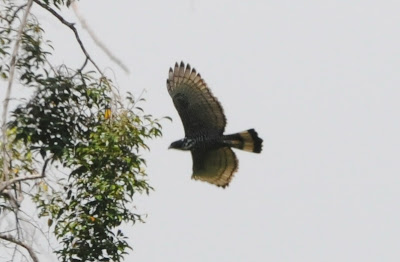
The other common raptor here is Blyth's Hawk-Eagle (Nisaetus alboniger), and sure enough one came by as we watched the Serpent-Eagle. As we watched, too, a large caterpillar somehow managed to get down the back of my neck. As I tried to brush it away (without realising what it was) the creature loaded my hand with stinging bristles - requiring an unscheduled stop at the resort HQ where we laboriously removed as many of them as we could (though not all, alas) with a pair of tweezers. Not all natural experiences are pleasant ones…
Oh, well. There were still birds, plants and butterflies waiting for us at the border overlook point, and I wasn't about to be derailed by a caterpillar. So off we went to see Buff-vented Bulbuls (Iole olivacea) visiting a fruiting tree...

and flocks of the active and ubiquitous Chestnut-crested Yuhina (Yuhina everetti), a common Bornean endemic.
Here is another active and acrobatic forager: a Rufous-fronted Babbler (Stachyridopsis rufifrons).
Not for the first time, as I photographed plants along the ridge top trail, I regretted the absence of a good botanist.
Does anybody know what these are?
This is clearly (I think) a fern of some sort.
This may be some sort of ginger.
A few more botanical puzzlers: some fallen seeds, and an odd collection of sprouts.
This one I recognise: it is an umbrella moss, a member of the genus Hypnodendron or one of its close relatives (Hypnodendron itself may be a collection of mosses that are not each other's closest relatives, so there you are). Umbrella mosses of one sort or another range from Southeast Asia to New Zealand.
This, of course, is not a plant but a fungus; at a guess I would say it is an ascomycete of some sort, but that's as far as I can go.
I'm on firmer ground with the butterflies. This is a Malay Viscount (Tanaecia pelea). I at first took it for a related species, T. orphne, but the arrow markings on the forewing of that species point outward. Here, they clearly point inward, so pelea it is. [Update: well, no. I now believe this to be a female Horsfield's Baron - see below for the male. I guess I'm not on as firm ground as I thought!]


This one is a Tawny Bush Brown or Common Bush Orange (Mycalesis anapita fucentia).
After much checking on the web, I finally ran down a few photos of this or a very similar butterfly, identified as Faunis stomphax. It doesn't appear to have a common name, but other butterflies in this genus are known as fauns or duffers.
This is a male Horsfield's Baron (Euthalia, or Taenecia, iapis), one of a number of similar butterflies in the region. It is a Sundaland endemic, confined to areas - Sumatra, Borneo, West Malaysia, Palawan - that sit on the Sundaland Plate and were, during the last ice age, united into a single land mass. [for some reason some Bornean references call this Forsfield's Baron, but I think Horsfield's is correct]
This handsome insect is probably a true bug (Heteroptera), possibly a member of the scentless plant bug family (Rhopalidae).
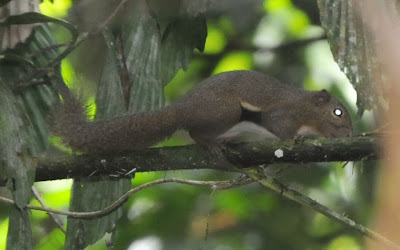
This squirrel is a bit of a puzzler. In this part of Borneo it should be a Plantain Squirrel (Callosciurus notatus), but this animal has a whitish, not a reddish, belly. There are two other similar squirrels on Borneo, the Bornean Black-bellied Squirrel (C. orestes) and the Ear-spot Squirrel (C. adamsi), but they both have a pale spot behind the ear which this animal seems to be lacking, and they shouldn't be at this end of Sarawak anyway. It most closely resembles a Sunda Black-banded Squirrel (C. nigrovittatus), but that species isn't supposed to be in Borneo. For a similar animal from Bako National Park, also near Kuching, see here.
Anyway, I sent this photo (and the link to the Bako image) off to Dr. Richard Thorington, senior author of the excellent Squirrels of the World, to see if he could help out. He replied, in part: "Though it is hard to rely on photographs, this animal does seem to resemble Callosciurus nigrovittatus more than any other species. On page 144 of Squirrels of the World I describe the subspecies C. n. klossi, which is found on "Saddle Island, west of Kalimantan (Indonesia)." It is described as "blue-bellied", similar to C. orestes, but not as highly colored and lacking a pale patch behind the ear. Your photograph, and the one taken near Kuching, may indicate that the range for nigrovittatus is more extensive than we show."
I therefore sent it on to Quentin Phillipps, who is currently preparing a new guide to the mammals of Borneo. Quentin commented: "I suspect that the Bako squirrel could just be a pale C. notatus whereas you have got a relict C. nigrovittatus which has hung on in the hills of western Sarawak. Once I have checked the museum skins I will let you know what I think. Very interesting indeed if something like this has been missed all these years."
So we appear to have a mystery on our hands!
From the overlook we headed down to path behind the Jungle Cabin, a part of the resort I had not visited before. Here we found, among other things, some university students setting out mist nets as part of a bird population survey.
We also found this attractive little flower, and once again I have no idea what it is!
This dainty little dragonfly appears to be a female Trithemis aurora.
Much more fascinating for me was this beautiful insect. I found it hovering at about ankle height over a trailside puddle in the woods behind the cabin.
It was a member of the family Aeshnidae, known as darners in North America, and the first one that I had been able to examine closely in Borneo (which probably says more about my dragonfly-hunting abilities than about Bornean aeshnids). Like other aeshnids (but unlike most libellulid dragonflies such as Trithemis) it perched by hanging vertically, but unlike North American darners I have seen it landed only only a foot or so above the ground.


The question, of course, is "what species is it?" After checking the books I decided, mostly on the basis of the long structures (the superior appendages) at the end of its abdomen, that it was probably a male Gynacantha basiguttata (the wasp waist is feature of males), a common species found from Bangladesh to the Philippines. I was not sure, though - the various Gynacantha species can be pretty similar to each other - so I sent the photos along to Dr. Rory Dow, an expert on Bornean odonates. He agreed, more or less, with my identification, but warned me that "with the SE Asian Aeshnidae it is not always possible, if one is being honest, to put a name even to a male specimen in good condition, at the moment anyway, they are a taxonomic mess. However, basiguttata seems likely, certainly it is not dohrni/demeter or bayadera or limbalis." We have a lot to learn about the relationships of Bornean dragonflies, and in the meantime this lovely creature will have to remain a "maybe".
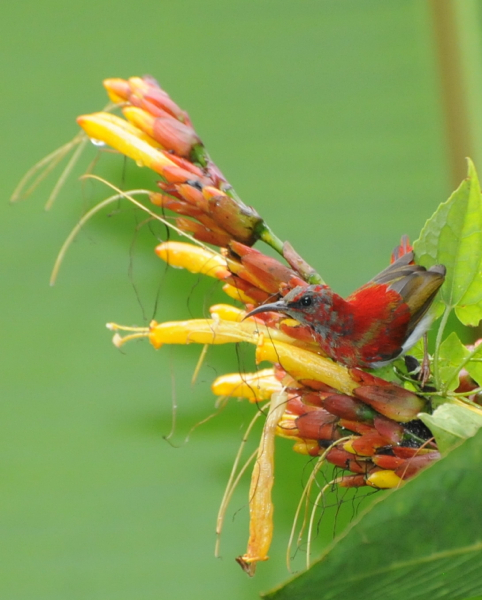
From beautiful insects to beautiful birds (in this case, on beautiful flowers!): this is a male Temminck's Sunbird (Aethopyga temminckii), presumably a young male moulting into breeding plumage.
In Borneo, Temminck's is a highland species, unlike the rather similar Crimson Sunbird (Aethopyga siparaja), a common bird in Kuching gardens. Unlike the Crimson, it has a red tail (as you can see in this photograph).
To the best of my recollection, this is the first time I have seen Temminck's Sunbird at Borneo Highlands (they are common enough at the other end of Borneo, on Mount Kinabalu). It is nice to know that each time I come here (or to the other places near Kuching I have celebrated in this blog), there is always the chance of finding something beautiful and new.