The Genting Highlands outside of Kuala Lumpur are best known for their casino complex, but - as I learned on my last visit to the area in 2010 - they have a lot to offer a non-gambling naturalist as well.
If nothing else, the view is probably the nicest in the area (and the cool highland air is a pleasure, too).
Anyway, after seeing Eileen off on her trip to Israel I still had a day to spare before I had to fly to Bangkok, so when my birding pal Bing Lim offered to take me up for a morning in the highlands I was delighted at the chance. Besides, on my last visit I had failed to come up with a single presentable bird photograph, and I intended, this time, to remedy that. So, on February 26, 2013, off we drove to the highest point of the Genting road, where it ends at a military weather station.
Even without birds, the road up to the station takes you through some fascinating country. The roadside vegetation is very different indeed from the tropical plant life of lower elevations.
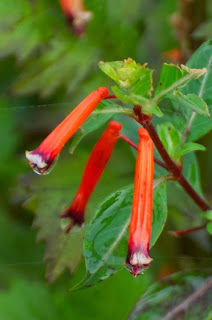
Not all of it, though, belongs here. Thanks to some helpful comments to my last Genting post, I now know that these lovely little red flowers scrambling over the bank are actually Cuphaea ignea, the Cigar Plant, a garden escapee originally native to Mexico (and a member of the Lythraceae, the loosestrife family).
As for some of the other roadside plants - well, my botanical ignorance is showing again… a Dianella, perhaps, based on comments on my earlier post?
This, though, is a fairly easy one: Bamboo Orchid (Arundina graminifolia), a common roadside plant throughout the highlands.

I found this pretty little moth on the wall of one of the station buildings. It appears to be a species of Abraxas, a large genus of looper moths in the family Geometridae.
On the open ground around the station we found a few Olive-backed Pipits (Anthus hodgsoni), winter visitors in Malaysia.
We also found a pair of Black-throated Sunbirds (Aethopyga saturata), but the strikingly-coloured male proved, alas, skittish. I had to settle for this poor shot of the female.
Below the weather station is a misty, bedraggled and almost elfin forest, whose birds are often merely voices behind a dense wall of vegetation.
There are some highly attractive flowers to be seen (again, unidentified by me - help from readers would be appreciated). [Thanks to Sean L, who identified this as an orchid of the genus Spathoglottis - see his comment below. I didn't even spot it as an orchid!]
I don't know what this is, either. I like the look of it, though.
There are three species of pitcher plants (plus hybrids) here, too - this is the common one, Nepenthes sanguinea.
This time around, the mountain forest birds decided to be cooperative - starting with the subtly-beautiful Chestnut-tailed (or Red-tailed, or Bar-throated) Minla (Chrysominla strigula).
+DSC_6710.jpg "Javan Cuckooshrike (Coracina javensis)")
Less colorful, but sleekly handsome anyway: a Javan Cuckooshrike (Coracina javensis).
A sure sign that you are in the high country: a Mountain Leaf-warbler (Phylloscopus trivirgatus), a bird that doesn't usually descend below 1300 m above sea level.
Calling this bird a Mountain Tailorbird (Phyllergates cumulates) is, in a way, only half right: it certainly is a bird of the mountains, ranging from about 1050-2000 m in Peninsular Malaysia, but it isn't a tailorbird. Not only does it not build its nest among leaves that it stitches together, like "real" tailorbirds, but DNA studies show that it isn't even in the same family as the others. instead, it is closest to the bush-warblers, in the newly-erected family Cettiidae.
+DSC_6702.jpg "Lesser Shortwing (Brachypteryx leucophrys)")
Here is the bird (and photo) of the day. On my last trip the loud musical songs of the Lesser Shortwing (Brachypteryx leucophrys) seemed to be everywhere, but of the bird itself - a genuine skulker - I could catch not a glimpse. This time the songs were there again - there must be lots of these birds in the high country - and I was determined to see one. OK, I cheated; I played a tape (judiciously!). My reward was this splendid male (yes, he's annoyed - you can tell, I think, by his fluffed-out white eyebrows, which are normally concealed. or almost so). The blue colour brands this as a typical member of the southern race wrayi; further north, males are mostly brown.
A female shorting presumably his mate, looked in too, but stayed deeper in the recesses of the undergrowth.
From the top of the weather station road we moved down to the forest around the Awana Resort, now identified as an Important Bird Area by Birdlife International.
Here the forest is less windswept, warmer and more open.
Middle- and lower-elevation animals start to show up, too. We found this flying dragon (Draco sp. - I don't know which one) doing its typical imitation of a dead twig (with legs) on the side of a tree trunk.
Coming down another trunk for a look at us: a Grey-bellied Squirrel (Callosciurus caniceps concolor).
The bird life is rather different too: no minlas or shortwings, but a face-off between two male Orange-bellied Leafbirds (Chloropsis hardwickii).
We were searching for one bird in particular, and found it (or rather, a pair of them): the Silver-breasted Broadbill (Serilophus lunatus). Though not the most colourful of its family, I think it is one of the loveliest. This is a male.
This may be one of the relatively few birds in which the female, at least in some populations, is the more attractive sex, its throat and breast set off from each other by a thin silvery-white line. This band is particularly prominent in the Malaysian race rothschildi.
In Malaysia, and further south in Sumatra, the Silver-breasted is a highland bird, or at least (in Malaysia) of middle elevations from 600-1200 m. I first saw this species in Vietnam, where it is a lowland bird; the farther south you go in its extensive range, the higher up the birds live.
They are, at any elevation, very nice birds, and they provided a lovely end to end a most gratifying morning.




+DSC_6664.jpg "Olive-backed Pipit (Anthus hodgsoni)") On the open ground around the station we found a few Olive-backed Pipits (Anthus hodgsoni), winter visitors in Malaysia.
On the open ground around the station we found a few Olive-backed Pipits (Anthus hodgsoni), winter visitors in Malaysia.+DSC_6690.jpg "Black-throated Sunbird (Aethopyga saturata)") We also found a pair of Black-throated Sunbirds (Aethopyga saturata), but the strikingly-coloured male proved, alas, skittish. I had to settle for this poor shot of the female.
We also found a pair of Black-throated Sunbirds (Aethopyga saturata), but the strikingly-coloured male proved, alas, skittish. I had to settle for this poor shot of the female. Below the weather station is a misty, bedraggled and almost elfin forest, whose birds are often merely voices behind a dense wall of vegetation.
 There are some highly attractive flowers to be seen (again, unidentified by me - help from readers would be appreciated). [Thanks to Sean L, who identified this as an orchid of the genus Spathoglottis - see his comment below. I didn't even spot it as an orchid!]
 I don't know what this is, either. I like the look of it, though.
 There are three species of pitcher plants (plus hybrids) here, too - this is the common one, Nepenthes sanguinea.
+DSC_6669.jpg "Chestnut-tailed Minla (Chrysominla strigula)")
+DSC_6707.jpg "Chestnut-tailed Minla (Chrysominla strigula)") This time around, the mountain forest birds decided to be cooperative - starting with the subtly-beautiful Chestnut-tailed (or Red-tailed, or Bar-throated) Minla (Chrysominla strigula).
This time around, the mountain forest birds decided to be cooperative - starting with the subtly-beautiful Chestnut-tailed (or Red-tailed, or Bar-throated) Minla (Chrysominla strigula).+DSC_6664.jpg "Olive-backed Pipit (Anthus hodgsoni)")
+DSC_6690.jpg "Black-throated Sunbird (Aethopyga saturata)")

%2BDSC_6669.jpg&container=blogger&gadget=a&rewriteMime=image%2F* "Chestnut-tailed Minla (Chrysominla strigula)")
%2BDSC_6707.jpg&container=blogger&gadget=a&rewriteMime=image%2F* "Chestnut-tailed Minla (Chrysominla strigula)")
+DSC_6710.jpg "Javan Cuckooshrike (Coracina javensis)")
+DSC_6697.jpg "Mountain Leaf-warbler (Phylloscopus trivirgatus)")
+DSC_6700.jpg "Mountain Tailorbird (Phyllergates cuculatus)")
+DSC_6702.jpg "Lesser Shortwing (Brachypteryx leucophrys)")
+DSC_6705.jpg "Lesser Shortwing (Brachypteryx leucophrys)")


+DSC_6749.jpg "Grey-bellied Squirrel (Callosciurus caniceps concolor)")
+DSC_6716.jpg "Orange-bellied Leafbird (Chloropsis hardwickii)")
%2BDSC_6738.jpg&container=blogger&gadget=a&rewriteMime=image%2F* "Silver-breasted Broadbill (Serilophus lunatus)")
%2BDSC_6721.jpg&container=blogger&gadget=a&rewriteMime=image%2F* "Silver-breasted Broadbill (Serilophus lunatus)")
%2BDSC_6728.jpg&container=blogger&gadget=a&rewriteMime=image%2F* "Silver-breasted Broadbill (Serilophus lunatus)")
%2BDSC_6729.jpg&container=blogger&gadget=a&rewriteMime=image%2F* "Silver-breasted Broadbill (Serilophus lunatus)")


+DSC_6464.jpg "Common Three-Ring (Ypthima pandocus corticaria)")

+DSC_6633.jpg "Commander (Moduza procris milonia)")
+DSC_6624.jpg "Common Imperial (Cheritra freja)")

+DSC_6484.jpg "Common Mime (Papilio clytia f. clytia)")
+DSC_6488.jpg "Common Mime (Papilio clytia f. clytia)")
+DSC_6492.jpg "Common Mime (Papilio clytia f. clytia)")

+DSC_6601.jpg "Malayan mahseer (Tor tambroides)")


