In the second of three posts following my hike through Singapore's Central Catchment Nature Reserve on August 8, 2014, we will concentrate on invertebrates - in this case, with one exception, all of them insects. Some were obvious; others, or their signs, much less so. I assume these tiny white objects are some sort of insect egg; I'm not certain of that, but if they are indeed animal in origin they will make as good start as we look at the smaller creatures of the forest.
This is our only guaranteed non-insect - a spider, of course, but I have no idea which one.
The problem with insects, and especially with beetles, is that there are far too many of them. There is nothing wrong with this from an ecological point of view, of course, but for a non-entomologist trying to figure out which species is in front of his camera lens the task, in the midst of a plethora of potential possibilities, can be daunting (that may be one of the attractions of dragonflies - they are, by virtue of being far less diverse, much more learnable. All I can say about this lovely little creature, by contrast, is that it is a leaf beetle of some sort.
This, of course, is a cockroach (and a fairly large and handsome one) but I have been unable to give it a name. Singapore naturalists reading this are welcome to help me out!
Things get even tougher when faced with the cockroaches' nearest relatives, the termites. Frequently the not sign of them is not the insects themselves but their nests (which are probably quite identifiable by a specialist, but then I am not a specialist).
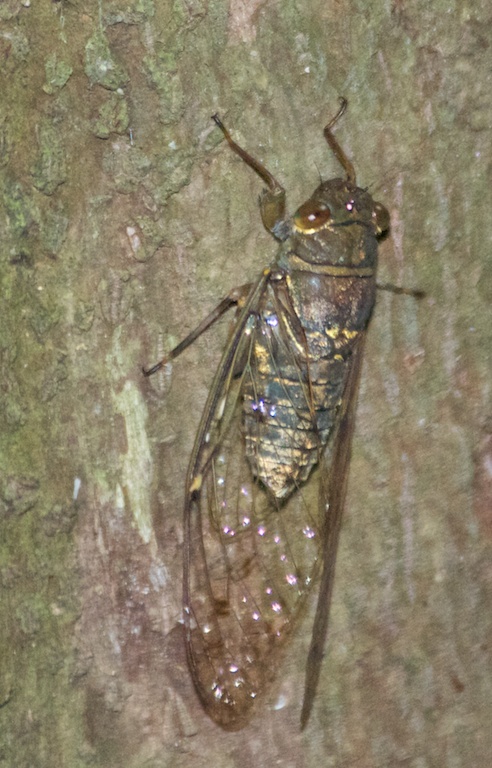
I can do marginally better with the cicadas, thanks to the number of expert Singaporean macro photographers whose work, with names attached, is available on the web. This fine iridescent specimen appears to be a member of the genus Platylomia.
It always surprises me that, while cicadas in Canada can fill a woodland with a blast of high-pitched noise that would drown out a chorus of buzz-saws, their counterparts in the tropics, if not quieter, are far less annoying. Could this be because cicadas are far more diverse in the tropics, and the different species produce a variety of sounds with a variety of pitches and timbres instead of blending into a single, ear-piercing drone?
This, gentle readers, is a bug (I mean a true bug, a member of the Order Hemiptera). I know that I am not being extraordinarily informative here, but aside from suggesting that it is one of the shield or stink bugs (Family Pentatomidae) that is the best I can do.
This, too, is a bug: a nymph of a flatid bug (Family Flatidae), hidden beneath its collection of long, waxy filaments.
Dragonflies and damselflies were pretty much absent on our walk, though I did find this damselfly, apparently a newly-emerged female of one of the two Vestalis spp. in Singapore, clinging to the tip of a leaf in typical fashion. In time she will acquire the brilliant emerald green of a mature adult, but for now she is a pale, washed-out colour, enough to make one (or at least me) wonder if he has stumbled across something new.
Thanks to the bevy of knowledgeable Singaporean insect photographers mentioned above, I can actually dentist this grasshopper to species. It is (fanfare) Xenocatantops humilis, a common member of the Family Acrididae, and that is about all I know about it.
Where there is a grasshopper, Aesop tells us, there should be an ant. Here it is - a Weaver Ant (Oecophylla smaragdina).
I am, I'm afraid, not much better at night-flying moths, though I was intrigued by this one we found sheltering under a leaf, waiting for the dark.
The day-flying moths we call butterflies, though, are much easier to deal with, thanks to Khew Sin Khoon's excellent A Field Guide to the Butterflies of Singapore. it is thanks to that book that I now know (or at least I think I do - this is a tricky genus) that this is a Dark Brand Bush Brown (Mycalesis mineus macromalayana). The "brand" referred to in its English name is a small, dark mark, or sex brand, on the male's forewing, covered with and toxins - specialized scales that produce pheromones useful in attracting females.
The Banded Yeoman (Cirrochroa orissa orissa) is a widespread, and subtly attractive, butterfly of forest edges in Malaysia as well as in Singapore.
The Malayan Lascar (Lasippa tiga siaka) seems to owe its name to the racial attitudes of colonial entomologists. It is very similar to a number of butterflies, in the related genus Neptis, that are generally known as "sailors". Sailors (the butterflies) have a nearly identical pattern, but their stripes are generally white on a black background. "Lascar" is an old term for a sailor from south or southeast Asia - so of course it was applied to brown butterflies with yellowish stripes.
I have featured the spectacular little Branded Imperial (Eooxylides tharis distanti) several times on this blog, but I hope my readers won't mind meeting it again.
Here are a pair of skippers, the Chestnut Bob (Iambrix salsala salsala) (top) and the Yellow Vein Lancer (Pyroneura latoia latoia) (bottom). Both are common in Singapore, though the latter is more likely to turn up in a nature reserve. The Yellow-veined Lancer, apparently, prefers the nectar of a single flower, the Bandicoot Berry (Leea indica), and that appears to be what it is perched on here.
This peculiar object gave us considerable pause. It turns out to be the abandoned pupal cage of a lichen moth (Cyana sp., Arctiinae). Cyana caterpillars are covered with extremely long hairs, and when they moult into pupae these hairs form the superstructure of the cage, in the middle of which the pupa hangs suspended by silken threads.
This may be a Cyana caterpillar. If not it certainly looks like one.
This larval case, woven of silk and bits of plant debris, is another sign of an insect more visible through its creations than on its own. It seems to be the work of a sort of bagworm, the larva of a member of the moth family Psychidae.
Other larvae were visible in their own person, but visible doesn't always mean identifiable. This is a caterpillar, but of what?
And what is this?
Surely this caterpillar, with its bright colours, long hairs and presumably warning eyespots, ought to be fairly obvious, but I have been unable to tell what it will become.
Unfortunately, warning colours aside, this one will probably never become an adult. A tiny parasitoid wasp has attacked it, and is presumably injecting its eggs within the caterpillar's body cavity. Its young will eat their host alive, from the inside, before maturing to do the same (at least the females) to other caterpillars.
Finally, a striking (and indeed rather fearsome-looking) caterpillar that I can identify: the larva of the Yellow Archduke (Lexias canescens). Its fearsome appearance, though, is a bluff: though many hairy or spiny moth caterpillars carry toxins that can do you serious damage (at least one South American species can kill you), butterfly caterpillars are, by and large, harmless.