 After a day at sea, our ship reached its final new port on Friday April 10: The tiny island of Little San Salvador in the Bahamas. The island, which lies not far from the long, serpentine island of Eleuthera, is wholly owned by Holland America Lines. "Little San Salvador" isn't a terribly romantic name, so Holland America has renamed its property "Half Moon Cay". It took me a bit of research to find out the real name of the place. I'm not an employee of Holland America, so, Dear Readers, it'll be Little San Salvador on this blog.
 Most of the cruise passengers never get past the shops just off the dock. That didn't include Eileen and I, of course, though the heat of the day did control our movements somewhat!
 Fortunately, the good folks at Holland America (or someone) have provided a genuine Nature Trail for us to follow. Little San Salvador is protected, I am happy to say, as a Wild Bird Preserve, and its brackish interior lagoon has been designated as an important wetland by the Bahamas National Trust.
 On the narrow, sandy strip between the island's south shore, where Holland America lands its passengers, and the interior lagoon, many of the plants are typical coastal species adapted to dealing with salt spray. This is a morning glory, one of a dozen species of the genus Ipomoea in the Bahamas -- almost certainly Ipomoea pes-caprae, the beach morning glory, a highly salt-tolerant species found on tropical beaches around the world. "Pes-caprae" means "goat's foot", and the cleft, two-lobed leaf does suggest a goat's hoof at least.
 Nonetheless, as this and the next two photos show, the island is far from treeless; there is some genuine woodland, known as coppice, on the north shore, but it was out of reach for us. On the south shore the vegetation is sandy scrub, with a few emergents like these palms (I assume they are some sort of thatch palm (Thrinax) but I would be glad to be enlightened further!)
 The scrub itself is pretty dense stuff, similar to the sort of thing you can see in the Florida Keys, with an undergrowth heavily laced with saw palmetto (Serenoa repens). It is, of course, bird habitat, and though it is not a rich as the coppice woodlands of the larger islands it still holds a few "Bahama specialties". Robert L. Norton reported 42 species from Little San Salvador (Fla. Field Nat. 21(1):16-17 (1993)), 36 of which he saw himself in a few hours. Probably only seven or eight of them, though, are land birds that actually breed there. For a visiting birder off a cruise ship, it is a question of quality, not quantity!
 Here, singing away, is a Thick-billed Vireo (Vireo crassirostris), a bird missing from Norton's list. Finding it here should not be a surprise; it is widespread in the Bahamas. This is a species with a most peculiar range: it seems to be a small island specialist, missing from the larger land masses of the Antilles but present on a few widely scattered islets. Besides the Bahamas, it lives on the Caicos and the Caymans, but is only a rare stray to Cuba and South Florida. A population of vireos on the distant island of Providencia in the far southwest Caribbean was once also thought to be this species, but according to my graduate supervisor, and leading vireo expert, Jon C. Barlow (who, sadly, passed away recently), the Providencia birds are actually Mangrove Vireos (V. pallens).
 Even more interesting are the ubiquitous Bananaquits. Bananaquits, of course, are widespread in the West Indies and indeed have a huge range in Central and South America. Nowhere, though, do they look the way they do in the Bahamas (compare the bird in these photos to the Virgin Islands Bananaquit in my last blog entry). You could be forgiven for thinking these almost entirely black-and-white little birds, patched with yellow on the chest, belonged to a different species altogether from their primarily grey-and-yellow, dark-throated compatriots elsewhere in their range.
 The truth, apparently, is more interesting. You can read all about it in a study published in 2008, "The dynamic evolutionary history of the bananaquit (Coereba flaveola) in the Caribbean revealed by a multigene analysis" by Eva Bellemain, Eldredge Bermingham and Robert E Ricklefs (BMC Evolutionary Biology 2008, 8:240). It appears that the various populations of Bananaquit have a complex evolutionary history, involving a number of island-hopping colonizations and invasions. Most island birds originally reached their homes from the mainland, but Bananaquits (or so their DNA tells us) actually evolved in the Bahamas and the Greater Antilles (their closest relatives, oddly enough, appear to be grassquits and West Indian "bullfinches"), and spread to the rest of their range, including the mainland, from there. The Bahamas birds apparently split from most of the others about 1.75-3.99 million years ago, but, oddly, they have genetic similarities to birds from islands off the Yucatan Peninsula (such a Cozumel) that otherwise look like "typical" birds from other areas. There are no Bananaquits on Cuba, which lies between the Bahamas and Mexico; were they there once, long ago -- and if so, what did they look like?
 All this matters very little, of course, to a naturalist simply enjoying being among bold, tame birds with lots of personality. For that, one species even beats the Bananaquit: the Bahama Mockingbird (Mimus gundlachii) -- another bird with a peculiar range, by the way; other than in the Bahamas (and occasionally Florida, where I saw one in Key West many years ago), it shows up again in the dry southwest of Jamaica.
 Bahama Mockingbirds are duller and streakier (though larger) than the Northern Mockingbird (M. polyglottos) so common in nearby areas like Florida and Jamaica, but is none the less charming for that.
 On Little San Salvador, they are noisy and bold, and take full advantage of cruise visitors.
 This one is checking us out at a picnic table, waiting to see if we will drop any tasty scraps. The birds will hop right onto the table to get them - behaviour which, I am sorry to say, annoyed some of our fellow passengers. Not all cruise passengers, alas, are naturalists.And with that, I come to the end of our cruise -- a week-long trip that it has taken me seven months to get around to writing up. It' a sad thing, I know, when our lives conflict with or blogging duties -- I'll have to do better in future....
!
 Wednesday April 8 found us anchored off St. Thomas in the British Virgin Islands. St. Thomas, unlike Grand Turk but like Puerto Rico, is a high island, but one that is not high enough to capture and hold the trade winds that bring rain to Puerto Rico. As a result, St. Thomas (like the other Virgin Islands) is covered in dry scrub. There are no endemic birds here.
 Pearly-eyed Thrashers (Margarops fuscatus) penetrate right into the town of Charlotte Amalie; this one was singing in a suburban garden.
 After a stroll through Charlotte Amalie, Eileen and I decided to take a minibus tour around the island. This gave us a chance to see the native vegetation. the picture above gives you a pretty good idea of what it looks like: the trees are short and scraggly, and with water loss a real problem their leaves are quite small. The large leaves of the ground vegetation are stiff and thick (and often sharp-pointed, spiky and otherwise miserable to walk through), and may reduce water loss with waxy, more or less waterproof coatings.
 Closer looks at a few roadside plants (note the smallish leaves on the upper photo -- the technical term for this is microphyllous, which simply means "small-leaved").
 Seagrape (Coccoloba uvifera) is a common coastal tree everywhere in the Caribbean. What's more, its broad, thick leaves make it easy to identify. It is extremely salt-tolerant, withstanding both salty soil and sea spray with ease. Its fruits, when ripe, do look a lot like concord grapes (and are used to make jam), but the plant belongs to the buckwheat family (Polygonaceae), so it is a grape only in name.
 Green Iguanas (Iguana iguana), an introduced species, are everywhere in the countryside. At almost any place we stopped in roadside scrub, a bit if peering into the brush would turn up an iguana or two, ranging from bright green babies to hulking moss-grey adults.
 We didn't see a lot of birds on our drive around the island -- and the birds we did see, or hear, almost always turned out to be Bananaquits (Coereba flaveola). Being common, though, doesn't make Bananaquits any less fascinating. Why are these birds so phenomenally successful, particularly in the West Indies (they range from Mexico to Argentina)? Why is there only one species (though in a number of subspecies) across its huge range (a point I'll raise again in my next entry)? And just what are Bananaquits in the first place? The species is currently placed in a family of its own, the Coerebidae, and its relationships -- which surely lie somewhere in the tanager/warbler/American finch assemblage, but given that assemblage's vast size this isn't saying much -- are still an open question.
 Dry, scrubby, and, perhaps, not as biodiverse as a greedy naturalist might wish (at least on land), St. Thomas still has its beauties. I'm glad to have seen it.
If any birder reading this is, or is planning to be, or might be able to be, in the vicinity of Kuching, Sarawak, Malaysia on October 4, I hope that you will have a look at the following link. It will give you all the details of a Mini Bird Race being held at the lovely Borneo Highlands Resort, only a short drive from Kuching:http://www.borneohighlands.com.my/birdrace2009.htmlThis is a chance to visit one of my favourite places in Borneo, see some great birds and help the causes of birding and conservation in Sarawak. Borneo Highlands Resort provides the easiest access point to the Penrissen Highlands in western Sarawak. The Penrissen Range is not as high, and certainly not as well-known, as Mount Kinabalu (at the other end of Malaysian Borneo in Sabah), but it provides the chance of seeing some Bornean endemics that are hard to get at better-known sites. Bornean Barbets are everywhere, and the resort may be the best place on the island to see the peculiar Pygmy White-Eye. When I was last there, in March of this year, Blue-banded Pittas were singing right next to the road (though I admit seeing them was another matter!).Sarawak is far less developed as a birding destination than either West Malaysia or Sabah. This bird race, organized by the Malaysian Nature Society (Kuching Branch), deserves your support -- not just for their efforts, but because birding in Sarawak should be encouraged, not just for the pleasure of it but because it can contribute so much to conservation.I, unfortunately, will be in Canada and cannot be there (if I were in Malaysia I surely would be!). So please go if you can, and while you are there, see a bird for me!
 Our next stop, on Tuesday April 7, could not have been more different (at least within the Caribbean) from the flat, scrubby terrain of Grand Turk. Puerto Rico, easternmost of the Greater Antilles, is large enough, and high enough, to capture the moisture-laden trade winds blowing off the Atlantic. The trades blow in from the east, and so eastern Puerto Rico is humid; in the Luquillo Mountains of its northeastern corner, surprisingly close to the large, American-style capital city of San Juan, is the only truly tropical rainforest in the United States.
  Much of it is protected as the El Yunque National Forest (pronounced something like 'El Joon'-kway')
.
Unlike the other islands on our itinerary, Puerto Rico has endemic birds - some thirteen species, depending on your ideas about avian systematics. Our ship did not arrive until 10AM (the cruise directors obviously did not have birders in mind), but I hoped to make the best use of my time on shore to see some of the island's special birds. El Yunque is a lovely place, lush and green after the dry scrub of Grand Turk, its trees festooned with bromeliads and other epiphytes. A note to my Malaysian friends: if you are in a rainforest, but are not sure which hemisphere you are in (an admittedly unlikely event), check for bromeliads (other than domestic pineapples, of course). If you find them, you are in the Americas - they ocur nowhere else.
 The forest is graced with the delicate sprays of tree ferns. There are a number of species of tree ferns in the Puerto Rican rainforest, mostly members of the genus Cyathea (including, I think, the ones in this photograph, which are probably the widespread C. arborea). I am very fond of tree ferns -- I they are among the world's most beautiful and evocative plants -- and I am very glad that so many of them have had the decency to hang around for the last few hundred million years so that I could, eventually, enjoy them.
  This strange-looking object if the inflorescence of a forest palm - or, at least, the stalks supporting the inflorescence, spectacular even without the flowers (palm flowers are not too exciting at the best of times, of course).
 Birding rainforests can be hard on the neck. Eileen, who is not really a birder (she describes herself as a birdwatcher-watcher), prefers to enjoy the forest without risking injury to her cervical vertebrae.Fortunately for us, considering the time of day, birds were vocal and active (though usually well out of camera range). We even heard (but, alas, did not see) the elusive Elfin Woods Warbler (Dendroica angelae), a bird only discovered in the 1970s.
 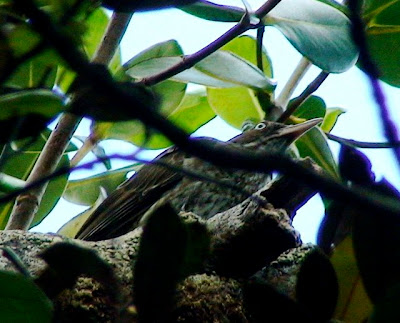 This is a much commoner (and non-endemic) bird, a Pearly-eyed Thrasher (Margarops fuscatus), one of a number of interesting thrashers endemic to the West Indies (including, for this species, Bonaire, where I first met it a few years ago). This is a highly aggressive species, and has been a source of trouble for Puerto Rico's rarest bird, the Puerto Rican Parrot (Amazona vittata).
 The parrots are almost impossible to see, but we did see this nest box, now abandoned, that had been erected for their use near the edge of the elfin forest.
 Puerto Rico's most distinctive bird (at least taxonomically) is the Puerto Rican Tanager (Nesospingus speculiferus). It is the only member of its genus, and its affinities (like those of many other birds traditionally considered "tanagers" but which have turned out to be something else) remain unclear. Is it a tanager (it doesn't seem much like one)? I have no idea, but I was pleased to find that it is common, noisy and relatively tame at El Yunque.
 The Scaly-naped Pigeon (Patagioenas squamosa), unlike the tanager, is widespread in the West Indies, but is not always easy to see. We saw several flying over the forest at El Yunque, and this one was considerate enough to pose at a reasonable (if not close) distance.
 Both the Pigeon and the Tanager seemed attracted to cecropia trees, though perhaps not for the same reasons. The pigeons, presumably, seek out the fruits; the tanager, a generalist omnivore, might be seeking fruit, hunting insects, or just hoping for a good view of the sky.
 On our way back to the boat we took a detour to the beach at Luquillo....
 ...Where the beachfront birds included common (and tame) Caribbean species including this Zenaida Dove (Zenaida aurita)....
 ... A Loggerhead Kingbird (Tyrannus caudifasciatus)...
 ...And several very bold Greater Antillean Grackles (Quiscalus niger), the bird Jamaicans call "kling-kling" in imitation of its bell-like calls.
Two months may seem like a long time between two entries on the same day's activities, but I have to plead (now that I'm back in Canada) the pressure of actual work! Anyway, in my last post I mentioned that the real wealth of Grand Turk (at least as far as wildlife is concerned) lay not above the sea but under it. I'm hardly an underwater photographer, and my "equipment" consisted of a plastic disposable waterproof camera, but I thought that I should at least try to devote one entry to proving my point. So, here are my wife Eileen and I waiting to go on our Grand Turk snorkeling trip. Whether it was "ultimate" or not I leave for you, dear reader, to decide, but it persuaded Eileen (who is no lover of the water) that she might just want to do it again sometime - a signal triumph, as far as I am concerned.
 So it's off the western end of Grand Turk, over the reef and into the water...
 ...where we are greeted by a large, fierce-looking but quite inoffensive Great Barracuda (Sphyraena barracuda) and a school of what I think are young Grey Snappers (Lutjanus griseus), hanging around for a possible handout.
 Caribbean reefs are (at least to my eye) quite different-looking from reefs in the Pacific -- more massively built, dominated by the spreading orange-rusty tines of elkhorn coral (Acropora palmata), so-called because of its resemblance to a giant stony set of moose antlers.[Moose are called elk in Europe. We in North America call our own wapiti, a close relative of the European red deer, elk, just to keep everyone confused -- all of which has nothing to do with coral reefs, of course.]
 Also massive, but entirely different in growth form, is brain coral (family Faviidae). This colony would appear to be grooved brain coral (Diploria labyrinthiformis). Notice the groove running down the middle of the ridges (the polyps grow in the "valleys" between the ridges, so I have no idea what the groves are for). If you want to know more about it, there's a nice writeup here.
 The beauty of this particular patch of reef owed a lot to the soft corals, including these sea fans. The yellow one at the top is probably a Venus sea fan (Gorgonia flabellum), while the lovely purple specimen at the bottom is more likely a common sea fan (G. ventalina). I would have had to examine details of the stem structure to be sure, and I didn't. The bushy dark brown candelabras in the background are soft corals too, some sort of sea whip (but I have no idea which one).
 Fishwatching on a coral reef is the underwater equivalent of birding, except that you can't use binoculars and the field guides tend to get soggy. However, photographing reef fishes with a plastic flashless disposable camera can be a bit trying, and I won't bore you with most of my hapless efforts. This supermale stoplight parrotfish (Sparisoma viride), however, makes for a good segue from my coral photographs, because parrotfishes eat coral. Notice the yellow "stoplights" on his tail.
The term "supermale" refers to the rather weird life history strategy of parrotfishes and at least some of their close cousins, the wrasses, in which females and, sometimes, young males can change into a new form, the supermale, differing in size, colour and often shape from its underlings. Supermales get to do most of the mating, and in some species take over "harems". If anything happens to the supermale, the dominant female in the harem turns into a supermale herself, and takes over. Away from the coral, on the sandy bottom, we found a few southern stingrays (Dasyatis americana). With a few unfortunate exceptions (the late Steve Irwin, for one), there are very few cases of stingrays injuring swimmers; as long as you don't actually step on them, rays won't normally bother you (in fact, in some places in the Caribbean stingray-petting sessions have become major tourist attractions). It never hurts, though, to keep a respectful distance.
 My one regret after our morning's snorkeling is that we only got a distant look at this little islet. It is apparently one of the homes of the Turks and Caicos Rock Iguana (Cyclura carinata carinata), a reare and eclining species confined to small islets fee of introduced mammals. There may be some 30,000 of them, but they are confined to a total land area of only 28 square kilometres, and a number of colonies have disappeared over the past few decades. They are a potent symbol of the islands (see here), and I would have loved to have seen one.
 From the East Indies (if anyone still calls them that) to the West Indies!After our return from Borneo and Hong Kong, Eileen and I flew to Florida to join my parents on a short cruise through the Caribbean. Our first stop, on Monday April 6, was the tiny, flat island of Grand Turk, near the eastern end of the Turks and Caicos Islands. The Turks and Caicos, though politically distinct, are biologically the southeasternmost part of the Bahamas, and their flora and fauna (with a few exceptions) are related to the rest of the Bahamian chain.
Mind you, not much of that biology was on view, at least above sea level, on the day we were there. Other than a few doves, there were no land birds in sight at all. Cruise stops, of course, are not ideal for wildlife-watching. You can rarely get off the boat until fairly late in the morning. On the other hand, what I saw may reflect the real situation. Only last September, Grand Turk lay directly in the path of Hurricane Ike. 80% of the island's homes were damaged, and the effect on its wildlife may well have been considerable. Other than wildlife, one of the chief points of interest above the waterline is, of all things, a replica of John Glenn's original space capsule Friendship 7, which splashed down near the island in 1962. The original is in Washington, DC at the National Aeronautics and Space Museum (though our taxi driver cheerfully claimed that this roadside monument was, in fact, the original capsule. Credulous tourists beware!).
 The only real town on Grand Turk, and the capital of the Turks and Caicos generally, is Cockburn Town. Like many another Caribbean city, its streets are lined with flowering trees. Unlike some others, though, the commonest flowering tree in Cockburn Town is a native species, the Geiger Tree (Cordia sebestena). Geiger Trees, though beautiful, are perhaps not as flashy as some of the exotics so widely planed in the tropics, but it is nice to see a town decorated with flowers that actually belong there.
 This little tree, however, is an exotic - the giant milkweed or bowstring hemp (Calotropis gigantea) from eastern Asia. It was being visited by numbers of visiting monarch butterflies, happy to find a local milkweed and apparently unconcerned by its alien origin.
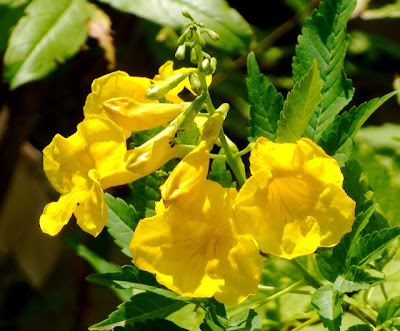 This is another common native plant, Yellow Trumpetbush or ginger-thomas (Tecoma stans). Its range goes well beyond the Turks, to the southwestern United States south to Central and South America, and it has become an exotic nuisance weed in the south Pacific.
 However diminished the wildlife of Grand Turk may be above the water, the situation beneath the waves is another matter altogether. Grand Turk is exceedingly fortunately situated as far as wealth of marine life is concerned. Only a few hundred metres off its eastern shore, the sea floor becomes a sheer wall plunging to over 2000 metres depth in places. In the photograph above you can see the edge of the wall, marked by the sudden change from azure to cobalt blue as the bottom drops away beneath the surface. The wall is rich in reef life (and is a magnet for scuba divers).
 What's good for life below the water is good for seabirds above it. While land birds proved hard to find on Grand Turk, Laughing Gulls (Larus atricilla) remained numerous, obvious, and, as far as this group outside Cockburn Town was concerned, easily approachable.
 So, of course, are the people of Grand Turk. These two little girls seemed to find me most entertaining (I guess not every tourist in Cockburn Town takes pictures of Geiger Trees)!

 After a day at sea, our ship reached its final new port on Friday April 10: The tiny island of Little San Salvador in the Bahamas. The island, which lies not far from the long, serpentine island of Eleuthera, is wholly owned by Holland America Lines. "Little San Salvador" isn't a terribly romantic name, so Holland America has renamed its property "Half Moon Cay". It took me a bit of research to find out the real name of the place. I'm not an employee of Holland America, so, Dear Readers, it'll be Little San Salvador on this blog.
 Most of the cruise passengers never get past the shops just off the dock. That didn't include Eileen and I, of course, though the heat of the day did control our movements somewhat!
 Fortunately, the good folks at Holland America (or someone) have provided a genuine Nature Trail for us to follow. Little San Salvador is protected, I am happy to say, as a Wild Bird Preserve, and its brackish interior lagoon has been designated as an important wetland by the Bahamas National Trust.
 On the narrow, sandy strip between the island's south shore, where Holland America lands its passengers, and the interior lagoon, many of the plants are typical coastal species adapted to dealing with salt spray. This is a morning glory, one of a dozen species of the genus Ipomoea in the Bahamas -- almost certainly Ipomoea pes-caprae, the beach morning glory, a highly salt-tolerant species found on tropical beaches around the world. "Pes-caprae" means "goat's foot", and the cleft, two-lobed leaf does suggest a goat's hoof at least.
 Nonetheless, as this and the next two photos show, the island is far from treeless; there is some genuine woodland, known as coppice, on the north shore, but it was out of reach for us. On the south shore the vegetation is sandy scrub, with a few emergents like these palms (I assume they are some sort of thatch palm (Thrinax) but I would be glad to be enlightened further!)
 The scrub itself is pretty dense stuff, similar to the sort of thing you can see in the Florida Keys, with an undergrowth heavily laced with saw palmetto (Serenoa repens). It is, of course, bird habitat, and though it is not a rich as the coppice woodlands of the larger islands it still holds a few "Bahama specialties". Robert L. Norton reported 42 species from Little San Salvador (Fla. Field Nat. 21(1):16-17 (1993)), 36 of which he saw himself in a few hours. Probably only seven or eight of them, though, are land birds that actually breed there. For a visiting birder off a cruise ship, it is a question of quality, not quantity!
 Here, singing away, is a Thick-billed Vireo (Vireo crassirostris), a bird missing from Norton's list. Finding it here should not be a surprise; it is widespread in the Bahamas. This is a species with a most peculiar range: it seems to be a small island specialist, missing from the larger land masses of the Antilles but present on a few widely scattered islets. Besides the Bahamas, it lives on the Caicos and the Caymans, but is only a rare stray to Cuba and South Florida. A population of vireos on the distant island of Providencia in the far southwest Caribbean was once also thought to be this species, but according to my graduate supervisor, and leading vireo expert, Jon C. Barlow (who, sadly, passed away recently), the Providencia birds are actually Mangrove Vireos (V. pallens).
 Even more interesting are the ubiquitous Bananaquits. Bananaquits, of course, are widespread in the West Indies and indeed have a huge range in Central and South America. Nowhere, though, do they look the way they do in the Bahamas (compare the bird in these photos to the Virgin Islands Bananaquit in my last blog entry). You could be forgiven for thinking these almost entirely black-and-white little birds, patched with yellow on the chest, belonged to a different species altogether from their primarily grey-and-yellow, dark-throated compatriots elsewhere in their range.
 The truth, apparently, is more interesting. You can read all about it in a study published in 2008, "The dynamic evolutionary history of the bananaquit (Coereba flaveola) in the Caribbean revealed by a multigene analysis" by Eva Bellemain, Eldredge Bermingham and Robert E Ricklefs (BMC Evolutionary Biology 2008, 8:240). It appears that the various populations of Bananaquit have a complex evolutionary history, involving a number of island-hopping colonizations and invasions.
  All this matters very little, of course, to a naturalist simply enjoying being among bold, tame birds with lots of personality. For that, one species even beats the Bananaquit: the Bahama Mockingbird (Mimus gundlachii) -- another bird with a peculiar range, by the way; other than in the Bahamas (and occasionally Florida, where I saw one in Key West many years ago), it shows up again in the dry southwest of Jamaica.
 Bahama Mockingbirds are duller and streakier (though larger) than the Northern Mockingbird (M. polyglottos) so common in nearby areas like Florida and Jamaica, but is none the less charming for that.
 On Little San Salvador, they are noisy and bold, and take full advantage of cruise visitors.
 This one is checking us out at a picnic table, waiting to see if we will drop any tasty scraps. The birds will hop right onto the table to get them - behaviour which, I am sorry to say, annoyed some of our fellow passengers. Not all cruise passengers, alas, are naturalists.


