On the way back from Punakaiki (see
previous post), Kerry-Jayne stopped at the Pororari River Track (in Paparoa National Park) to show me a unique, if unspectacular, plant. The Pororari winds through a spectacular forested
gorge on New Zealand's west coast, emptying into the sea at Punakaiki itself. The lush and humid forest along the track is particularly rich in ferns, and it
was a fern - of sorts - that we had come to see.
New Zealand is particularly rich in
ferns and the plants usually called "fern allies", though how closely related some of them actually are to ferns is open to question.
Many of Pororari's ferns grow
epiphytically - that is, on the trunks and limbs of trees. This one appears to be Microsorum scandens, a fern that features strap-like, undivided
juvenile fronds and deeply-lobed adult fronds in the same clump. The species is well-named: scandens means "climbing".
Here is the plant we were looking
for - not much to look at, but I was very excited to see it. It is Tmesipteris elongata, and when I studied botany as an undergraduate it was regarded
as one of the most primitive plants in the world. Tmesipteris, the fork fern, and it's only relative, Psilotum, the whisk fern - the so-called
whisk fern - were thought to be living representatives of the very first green plants to invade the land. Like these early plants, Tmesipteris and
Psilotum have neither roots nor leaves (the little structures that look like leaves on Tmesipteris, put simply, aren't. They lack vascular tissue,
the vessels that provide both support and transport in higher plants). What is more, they carry their packets of spores (sporangia, the little green
blobs that look vaguely like miniature olives) out in the open, as the earliest plants did (though not, as it happens, in the same way).
Unfortunately for this lovely idea,
it appears that Tmesipteris and Psilotum are simply ferns that have somehow lost their more advanced features. Modern molecular studies place
them close to the adder's tongue ferns (Ophioglossaceae). Oh well... I was still excited to find this little fellow, growing unobtrusively among less celebrated
plants.
Here is an epiphytic plant that is
neither a fern nor a fern ally, but a liverwort - don't ask me which one! Liverworts are not vascular plants, but are closer to mosses.
This is unquestionably a fern, and
to my eye it is one of the most unusual and striking of them all. I first saw kidney fern (Trichomanes reniforme) in 1974, on Little Barrier
Island. I was struck by it then, and was delighted to see it again so many years later.
The kidney fern belongs to the
filmy fern family (Hymenophyllaceae). It doesn't look too much like other filmy ferns, but it share with them
extremely thin fronds, only a few cell layers thick, that dry out very easily. Kidney ferns can survive drying, shriveling and then reopening when the rains
come, but their presence is a sign that the forests where they grow are, at least some of the time, humid places indeed. The little blobs around the rim of
this fertile frond are the spore-bearing bodies, or sori.
Here are some more traditional
ferns.I'm not sure what the upper plant is, but the lower one appears to be crown fern or petipeti (Blechnum
discolor).
I believe this to be one of the many New Zealand species of Coprosma - possibly karamu (C. robusta), but there are some fifty to choose from. We have Captain Cook's botanists to thank for the unlovely generic name, from the Latin copros, meaning dung. Apparently the specimens they collected stank up their shipboard cabins.
This is a Dracophyllum,one of the plants that gives New Zealand forests - at least to a northerner's eye - a distinctly exotic appearance. Though it doesn't look it, it is a relative of heathers and heaths (Ericaceae), as one of the plants formerly included in a separate, largely southern-hemisphere family, Epacridaceae.
In most parts of the world, if you found one tree busily engaged in trying to choke the life out of another, you would be safe in assuming that the murderer in
question was a strangler fig. In New Zealand, though, it is more likely to be a northern rata (Metrosiderosrobusta), a member of the myrtle
family (Myrtaceae). While other ratas (and other Metrosideros spp., like the famous ohia lehua (M. polymorpha) of Hawaii) usually grow from the ground up like
respectable trees, the northern rata starts life as an epiphyte high in the canopy. In time, like a strangler fig, its roots reach to the ground, forming a robust pseudotrunk that envelops
and, eventually, smothers its host (though there is some argument as to whether the rata actually contributes to the death of the host tree).
The result can be a truly impressive tree, reaching 25 m in height. This one, it seems is well on its way.
Kerry-Jayne Wilson lives in a magnificent spot. From her sitting room you can look out to the waters of the Tasman Sea...
Or, by turning around, you can look across the coastal plain to the distant ridge of the Southern Alps.
Kerry-Jayne is a noted New Zealand ornithologist, author of Flight of the Huia,a detailed history of faunal change in the islands, and a friend of Eileen's since her visit to Sarawak some years ago. From March 3-7, she was also our host and guide to the wild west coast of the South Island, where you can still get a taste of what New Zealand must have been like before agriculture, forestry and settlement tamed and reduced it.
Not least of the West Coast pleasures are the magnificent seascapes. On our first days with her, Kerry-Jayne took us to a pair of remarkable spots. Here are two views of the first - the nature reserve at the Cape Foulwind, named by Captain Cook after a particularly unpleasant encounter with the local weather (though Abel Tasman was the first Western explorer to see it, on 14 December 1642).
Cape Foulwind's chief attraction other than the scenery - as the interpretative sign makes clear - is its colony of Southern (or Australian, or New Zealand) fur seals (Arctocephalus forsteri).
Wildlife watching, however, can start in the parking lot. New Zealand has three species of gull; this is the commonest and most widespread of them, the Red-billed Gull (Chroicocephalus scopulinus). The bird at the top is an immature; the lower photo shows what I presume is a full adult, though in high breeding colour the bill should be entirely red. We were there, of course, in the off season.
A short boardwalk trail through the cliffside vegetation led us to the fur seal colony...
..past more stunning cliffside scenery, dotted with clumps of New Zealand flax (Phormium cookianum).
This is one of the hardier coastal ferns, shore spleenwort (Asplenium obtusatum). It is quite tolerant of the salt spray that must drench it on a daily basis.
Below us, trailing strands of big bull kelp (Durvillaea antarctica) swept back and forth with the incoming waves.
On the trail we had a chance to get on close terms with one of New Zealand's distinctive, and increasingly rare, birds. The Weka (Gallirallus australis) is a flightless rail, an oversized relative of the widespread Buff-banded Rail (G. philippensis) of the southwest Pacific. Wekas are bold and inquisitive, and utterly unafraid of people. Until recently, they appeared to be holding their own in many parts of New Zealand. Now, however, they have vanished from much of their range, and the west country is one of their few remaining strongholds. There are four subspecies; this one is the nominate race, the Western Weka G. a. australis.
Here is some video of a Weka in action.
By the time of our visit in March, the male fur seals had returned to the sea, leaving only females and still-nursing young stretched out on the rocks below.
The next day Kerry-Jayne took us to another coastal viewpoint, this time to see the famous "pancake rock" formations at Punakaiki. The entranceway features a grove of New Zealand's only native palm (and the most southerly palm in the world), the peculiar-looking nikau (Rhopalostylis sapida).
A nikau looks like nothing so much as a gigantic feather duster.
Unlike the granitic cliffs at Cape Foulwind, the rocks at Punakaiki are limestone - a series of hard limestone layers, separated from each other by a softer, easily-eroded mudstone.
The effect really does recall a stack of pancakes!
These peculiar formations were apparently created by stylobedding, a process in which the rocks were, basically, squashed flat under tremendous pressure followed by weathering of the mudstone layers.
The distinctive silhouette of a New Zealand cabbage tree (Cordyline australis) rises above the surrounding vegetation at Punakaiki.
Karamū (Coprosma lucida) was a valued medicinal plant for the Maoris.
Tutu (Coriaria arborea), on the other hand, is highly toxic. In the early days of European settlement it caused many livestock deaths,and it has has been responsible for poisoning circus elephants that ate it as they were being trouped around New Zealand. In one case, according to an online New Zealand encyclopedia, "Veterinarian David Marshall recalled that three elephants,
poisoned (but not fatally) while travelling through the
tutu-infested Buller Gorge, produced spectacular waist-high
piles of vomit."
And with that delightful image in mind, I shall leave you to contemplate the seaside scenery!
I first visited New Zealand in 1974, on my way home after two years working on my doctoral thesis in Australia. Since then, with one thing and another, I had never been back to either country. This year, though, Eileen (who had been to New Zealand in 2004) proposed that we vary our annual trip to Malaysia by routing ourselves through both, combining visits to Malaysian friends who had emigrated southwards with a chance for me to see, again, a natural world I have long loved, and long missed.
We had planned to arrive in Auckland on March 1st, and fly the next day to Christchurch for a stay of several days. The mammoth earthquake at the end of February changed all that. We decided instead to head out from Christchurch after only a single night, and cross Arthur's Pass to the wild West Coast of the South Island and Eileen's ornithologist friend Kerry-Jayne Wilson.
My plan, on crossing Arthur's Pass, was to walk the Otira Valley trail to one of the few remaining "easy" sites for the increasingly rare Rockwren (Xenicus gilviventris). This is one of the two surviving members the Acanthisittidae, an ancient relic that is New Zealand's most distinctive songbird lineage.
As it turned out, the wrens failed to appear and the "walk" to their rock scree habitat turned out to be more of a scramble than a stroll.
No matter (well, almost no matter). The climb to the scree was worth it botanically if not ornithologically. New Zealand has a rich and unusual subalpine flora, and the Otira Valley is as good a place as any to get on close terms with it.
I am a zoologist, not a botanist. Fortunately, later in our trip I was able to run my photographic sampling of the plants along the trail by a very genuine botanist indeed, Hugh Wilson (you'll meet him in a later posting). He avoids the internet, so I can cheerfully blame him for any misidentifications.
There aren't many trees in the valley, but down near the bottom of the trail we found this Bog Pine (Halocarpus bidwilli) - not a pine, but a member of the southern hemisphere conifer family Podocarpaceae, native to New Zealand. According to conifers.org, it is named for John C. Bidwill, an alpine plant fancier who collected in New Zealand in 1839 and 1848.
The bright red berry in this photograph is Pentachondra pumila, an alpine member of the Australasian heather family (Epacridaceae). What I didn't know until Hugh Wilson spotted it was that the really interesting plant in the photo is the scruffy-looking specimen creeping in from the left margin. It may look like a sort of badly-groomed moss, but it actually is Pygmy Pine or Mountain Rimu (Lepidothamnus taxifolius, Podocarpaceae), the world's smallest conifer.
These peculiar and attractive seed heads belong to Acaena inermis, a member of the rose family (Rosaceae). Acaena is a genus of 50 species, mostly in South America but with 19 native to New Zealand. Many of them have barbed seeds (presumably evolved to catch the feathers of passing moas?), but not this one.
This extremely attractive plant is Anisotome pilifera, a member of the carrot family (Apiaceae [or, if you're old-fashioned, Umbelliferae]). The genus Anisotome is endemic to New Zealand, with some sixteen species. The grass in the background is Bristle Tussock (Rytidosperma setifolia).
Tussock grasses are a feature of the alpine and subantarctic regions of the southern hemisphere. This one is Broad-leaved Snow Tussock (Chionochloa flavescens). Also crowding into the shot are Phormium cooki (the blade-shaped green leaves on the right), Dracophyllum longifolium (the tall spindly stuff at the back) and Celmisia semicordata (the silvery plant at the lower left).
The Snow Lily (Astelia nivicola) is one of the more robust plants along the trail, and its berries are certainly striking. Astelia and its several dozen southern hemisphere relatives (in the Pacific, the Falklands and the Mascarenes) have recently been placed in their own family, the Asteliaceae.
Mutton-bird Scrub (Brachyglottis rotundifolia) is a daisy-like shrub (Asteraceae or Compositae). The small-leaved plant clustering at the bottom of the upper photograph is Scarlet Snowberry (Gaultheria crassa - see below).
Celmisia is one of the most striking genera of New Zealand alpine plants - large, impressive daisy relatives with stiff, hairy leaves and, in autumn, crisp, dry flower heads. Most of the seventy species are found only in New Zealand. This one is Celmisia semicordata, the Mountain Daisy, also called Cotton Plant or, in Maori, Tikimu. It is endemic to lower alpine and subalpine areas in the South Island.
This is a more widespread mountain species, the Cotton Daisy (Celmisia spectabilis). The long, thin stems to its right, topped with a corona of stiff green leaves, belong to Hebe subalpina, one of about 100 species of Hebe (Scrophulariaceae) in New Zealand.
There is quite a range of size and shape among the Hebe species in New Zealand. This is Boxwood Hebe or Mountain Box (Hebe odora).
Yet another Celmisia - Armstrong Daisy (Celmisia armstrongi). The large, rather coarse-leaved fern at the right margin is Mountain Kiokio (Blechnum montanum).
Here is Blechnum montanum again, this time on its own.
Alpine Hard-Fern may not look very much like the previous plant, but it is a Blechnum nonetheless: Blechnum penna-marina.
I have a particular fondness for clubmosses - I don't know why; perhaps because they are such ancient plants, and I like to imagine what it must have been like to wander through a forest of tree-sized specimens back in the days of the Coal Age. This is Mountain or Alpine Clubmoss (Lycopodium fastigiatum), a species also found in Australia, surrounded by tufts of Poa grasses.
One of the lovely things about alpine plants is the way mats of several species can clump together, vying for attention. Here, a tangle of Creeping Clubmoss (Lycopodium scariosum) pushes its way through a patch of broad-leaved Celmisia discolor and the needles of Dracophyllum uniflorum.
March is autumn in New Zealand. Though there isn't much in flower, mushrooms are out, and a few, like these little orange members of (probably) the genus Cantharellula (Tricholomataceae), provide a welcome splash of colour.
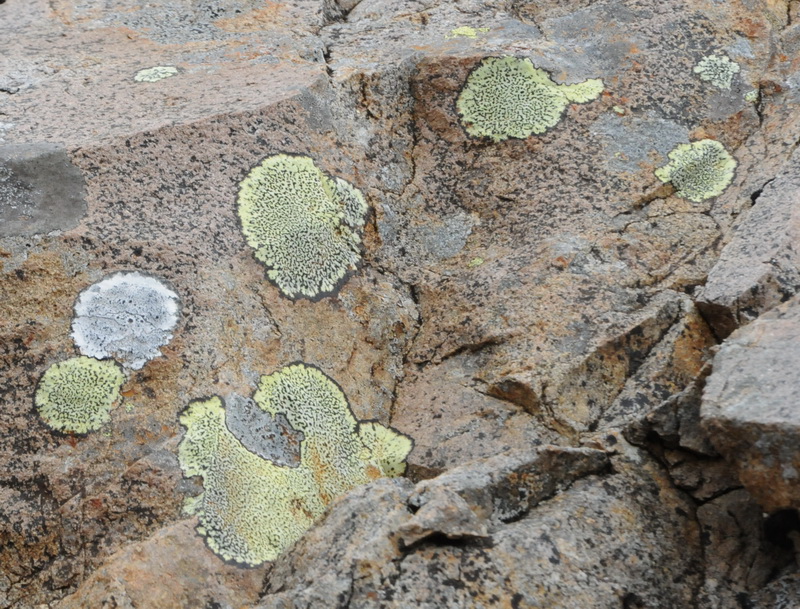
In contrast to the raft of New Zealand endemics growing in the valley, Map Lichen (Rhizocarpon geographicum) is about as cosmopolitan as a land organism (or, since lichens are symbiotic combinations of a fungus and an alga, a pair of organisms) can get. It ranges from Siberia and northern Canada to the fringes of the Antarctic continent. In 2005, examples were even launched into space aboard a Soyuz rocket as part of a survival experiment. After sixteen days of total vacuum, gamma rays and ultraviolet radiation, they were returned to Earth where they appeared none the worse for wear. Notice, by the way, the ring of black spores surrounding each greenish patch.
I confess I was surprised when Hugh Wilson identified this plant as a member of the genus Epilobium (Onagreaceae) (specifically as Epilobium glabellum, the Smooth Spike-Primrose or New Zealand Willow-Herb, the last name a bit misleading as the species is also found in Australia). It certainly did not remind me of our own Epilobiums back in Canada, which we call fireweeds because they sprout quickly after a fire. I suppose this is further proof that Hugh is a botanist, and that I am not.
I wish that this South Island Mountain Foxglove (Ourisia macrocarpa, Plantaginaceae) had been in flower, as its flowers - at least based on photographs - seem extremely attractive (and only vaguely like the flowers of its somewhat distant relative the garden foxglove (Digitalis purpurea)). Ourisia has an interesting distribution: 12 species in New Zealand, one in Tasmania, and a further 15 in the Andes of South America, where the genus apparently originated.
Scarlet Snowberry (Gaultheria crassa, Ericaceae) has red berries, but here it is the leaves that are providing a bit of autumn colour. Gaultheria, it turns out, is named for a Canadian botanist, one Jean François Gauthier (1708-1756), and I am familiar with the snowberry's better-known Canadian relative, Wintergreen (Gautheria procumbens) - so this plant was, in a way, a touch of home.
The little plant with the rosettes of greyish-green leaves is South Island Edelweiss (Leucogenes grandiceps, Asteraceae), a relative of the Rogers-and-Hammerstein Edelweiss (Leontopodium alpinum) of Europe.
These unusual parasol-shaped leaves (you can see them in the lower right of the lower photograph) belong to perhaps the most celebrated of the New Zealand alpines, the Mount Cook Lily (Ranunculus lyallii) - not a lily, but the largest buttercup in the world. I would love to see this species in flower one day!
You will have gathered by now that our visit was hardly in the height of the flowering season. There were, however, a few exceptions: this is one of them, a New Zealand Bluebell (Wahlenbergia albomarginata, Campanulaceae).
The only plant really flowering in abundance was Common New Zealand Gentian (Gentianella bellidifolia). Those of you used to gentians in other parts of the world may be wondering about this one - why isn't it cup-shaped, and why isn't it dazzlingly blue as so many gentians are? The questions become more interesting when you learn that all of New Zealand's thirty-odd gentian species have white flowers, as do most of its other showy flowering alpine plants.
Why are New Zealand's alpine flowers mostly white? Botanists, of course, have asked that question too. The answer seems too be tied, as is so much that is strange about New Zealand's biology, to the islands' long history of isolation. Colour in flowers is not for our eyes, but for the eyes of pollinators. In other alpine regions, the pollinators are mostly long-tongued bees with excellent colour vision and a fondness for blue - but not in New Zealand, where native bees of the right sort are missing and the flies and moths that do the job instead aren't particular about colour. No bees, no blue.
Animal life was notably scarce on the trail (aside from fellow hikers). This golden hunter (Sphictostethus nitidus) is an endemic member of the family Pompiliidae, a group of wasps that feed their young by providing them with paralyzed spiders.
There are only a few species of native butterfly in New Zealand, but even these few can create identification problems. This is one of the coppers, a quite difficult group. It appears to be a Boulder Copper (Lycaena (Boldenaria) boldenarum), the species you might expect in thus sort of country. The veins on the hindwing of the more widespread Common Copper (Lycaena salustius), instead of being marked with a solid dark streak as here, have a thin black line running along each side.
After a long hoof to the top of the trail, I was greeted by an expanse of rocky scree decorated with immense boulders. All I had to do now was spot a tiny brownish bird about the size of (and with much of the behaviour of) an extremely small mouse, and the Rockwren would be mine. Well, I didn't. Anyway, as Eileen's photograph shows, it's hard enough to see me in there, and I'm a lot bigger than your average Rockwren. Oh, well... at least it is nice to know that there are still reasonably accessible places where this tiny and ancient bird is hanging on. Long may it remain so!