On Friday, 30 August 2012, Eileen's mom came through her operation with flying colours. We all found our little ways to celebrate. Mine came inadvertently, with an offer from Vincent Wong to go out to the rice fields at Chupak for a Sunday morning's birding on September 2.
At Chupak, the villagers were tending the last of their harvest. Much of the rice had already been cut back - usefully for birders who want to see what might be stalking around the base of the plants. Some, though, was still awaiting harvest, and we arrived not just at a good birding time but in the midst - as you shall see - of a war between the rice farmers and the birds that also wanted a share of their crop.
Water birds, though, are no competition for rice growers, and I am sure the owner of this house would have no objection to the Little Egret (Egretta garzetta) standing guard in front of it.
Chupak is becoming a particularly good place for rails. We saw five species altogether, including Common Moorhens (Gallinula chloropus) and several family groups of the ubiquitous White-breasted Waterhen (Amaurornis phoenicurus). The Buff-banded Rail (Gallirallus philippensis), only last year a remarkable rarity at Chupak, now seems to be breeding. I saw at least three, and Vincent found a family with chicks.
White-browed Crakes (Porzana cinerea) seem to be common. This bird was perching atop a bush in most un-rail-like fashion.
This photo, though not particularly good, shows this species' very long toes; like the even longer-toed jacanas (Jacanidae), White-browed Crakes are adept at walking on floating vegetation.
Our fifth species was a single bird foraging quite openly in roadside vegetation (very close, in fact, to the house in the egret photograph above - as in fact were all five of the rails we saw).
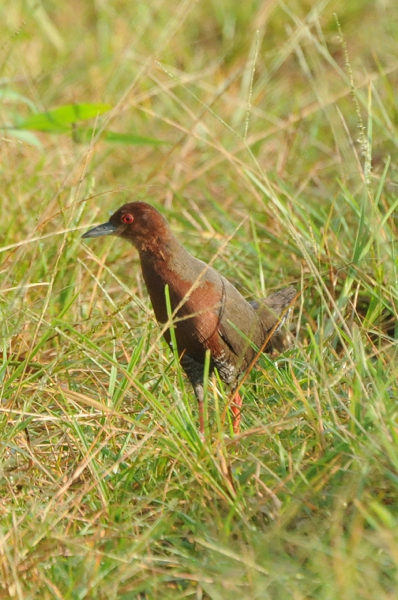
It was, to my astonishment, a Ruddy-breasted Crake (Porzana fusca), supposedly a rare bird in Malaysia (though with birds as elusive as crakes, the rarity may be more apparent than real). Anyway, it was a lifer for me.
I brought Vincent back from his family of Buff-banded Rails, but though the bird called a few times in response to a tape we did not see it again.
While looking for birds, of course, we came across other creatures, including this colourful little Green Paddy Frog (Hylarana erythraea).
As always, there were plenty of dragonflies in attendance along the edge of the paddies. Ictinigomphus decoratus is common enough, but it is large, striking and never fails to get my attention.
The female Diplacodes trivialis (above) looks very much like the more abundant Orthetrum sabina (which, for once, I am not including in this posting), but is smaller, with a shorter abdomen. The powder-blue male (below) is unmistakable.
Rhodothemis rufa is one of a number of similar red dragonflies; one clue to its identity are its eyes, which only just touch over the top of its head.
Another red dragonfly (and a very common one) is Orthetrum testaceum. It is very similar to another common species, O. chrysis; C. Y. Choong gives a nice run-down of the differences, which include a paler, more reddish-brown thorax in O. testaceum.
This photo records my first encounter with Acisoma panorpoides, a small dragonfly with a unique bottle-shaped abdomen. This is a female; the male, like the male Diplacodes, is largely blue.
Rhyothemis phyllis is one of the more elegant and striking of Borneo's dragonflies, and certainly one of the easiest to identify.
Here are a couple of other insects: a handsome bug that I would love to identify...[update! It's a tortoise beetle, a member of the family Cassinidae]
... and a common butterfly, the Striped Albatross (Appias libythea). This is a female.
Faithful readers of this blog may remember the Buckbean I wrote about recently in my account of the Bog Trail in Cape Breton, Nova Scotia, a member of the small aquatic plant family Menyanthaceae. This is one of its tropical cousins: the Water Snowflake (Nymphoides indica).
The ripening of the rice brought in hordes of munias, mostly Chestnut Munias (Lonchura atricapilla) - a delight to us but a menace to the struggling villagers, who did everything in their power to keep the birds from falling on their crops. This included shaking flags strung out on lines across the paddies, banging pots, and ringing bells - a full-time, wearying and no doubt dispiriting job.
It also included surrounding and covering the paddies with mist nets - not just a way of keeping the birds from the seed heads, but as a fatal trap.
Mist nets are designed not to reject, but to entangle. Birds diving for the crops, caught by a wing, head or leg, cannot get free, and soon die. We found many nets dotted with their bodies.
Birds are not the only things the nets catch; here, an entangled dragonfly - perhaps an Ictinigomphus - provides a bounty for a more fortunate wasp.
It's hard to blame the struggling farmers, uncomfortable as scenes like these may be to western birders. We can ask, though, if this is the best way to reduce the damage ricebirds undoubtedly cause. In Africa, studies have found that Red-billed Queleas (Quelea quelea), a serious crop pest, are first attracted to the fields by weed growth, and keeping down the weeds reduces the attacks. Would this work in Asia, where munias are less nomadic than Queleas and may stay in the area year-round?
In normal years, Eileen and I go back to Malaysia during the northern winter, when snow flies in Ontario and my Canadian heart yearns for somewhere warm and tropical. In June 2012, however, we received word that Eileen's mother in Kuching needed major surgery (not to keep you in suspense, the surgery was a complete success and she has recovered remarkably well). We had been planning to go to the UK after the July meeting of the Standing Committee of the Convention on International Trade in Endangered Species of Wild Fauna and Flora (CITES), which I attend on behalf of Humane Society International. Instead, though, we flew straight to Singapore from Geneva, and on July 31 we were back in Kuching.


Of course this was not a pleasure trip, and I dd not expect to get much time in the field (though I certainly didn't work as hard as Eileen, who was at her mother's bedside day and night). However, thanks to my friends Anthony Wong and Vincent Wong (not related), on August 5 I did have a chance to make a morning visit to the Sejingkat Ash Ponds, where Anthony is keeping track of migrating waders (shorebirds to us North Americans).
I would have thought that most waders would still be on their northern breeding grounds in early August, and that there would be little to see. I was, happily, wrong.
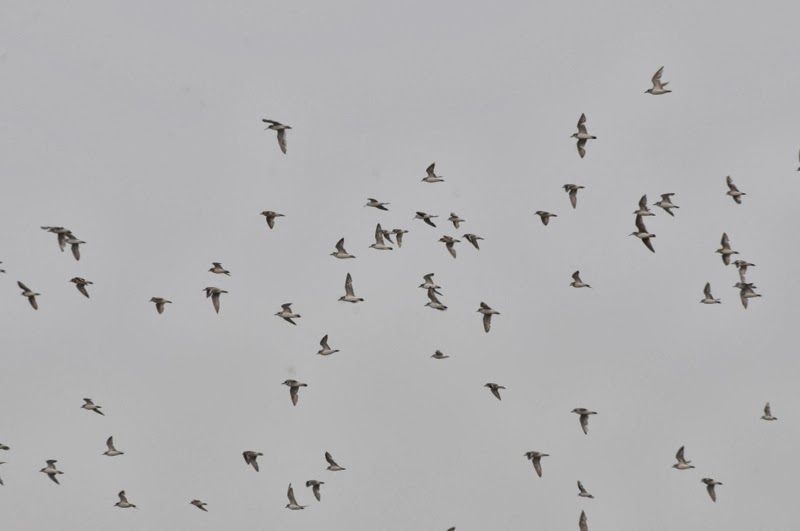
Swirling flocks of birds circled the ponds, where they feed on insect larvae and other invertebrates until falling tides uncover the sand islands out in Buntal Bay, where most of the birds spend the rest of their time.
I could not get terribly close to them - this was birding, by and large, by telescope - so most of my photographs look like this.
Here is a somewhat better look. These are Marsh Sandpipers (Tringa stagnatilis), identifiable by their markedly thin bills.
Here are a group of Lesser Sandplovers (Charadrius mongolus) in various stages of plumage, with a few Terek Sandpipers (Xenus cinereus) thrown in (the ones with long, upturned bills and orange legs).
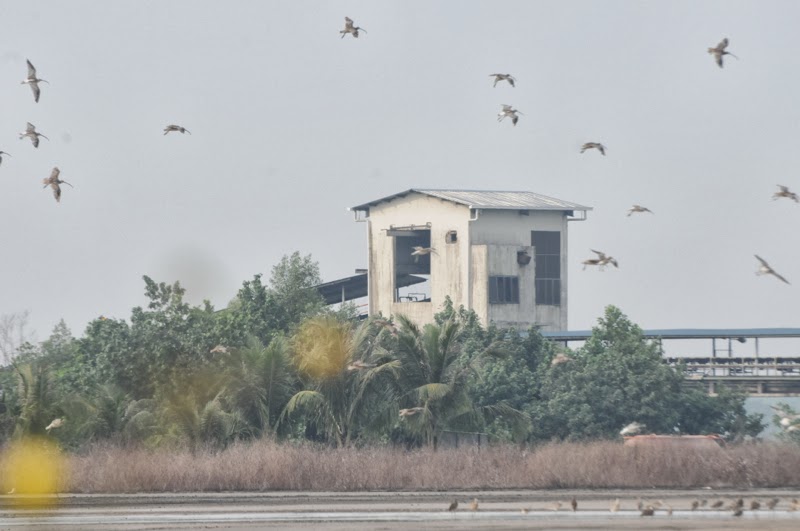
One of the most interesting things about wader-watching at Sejingkat is the opportunity to compare Eurasian and Far Eastern Curlews (Numenius arquata and N. madagascariensis). Both winter here in numbers.
If you want to see really good photos of the two species, with useful ID notes, hop over to Dave Bakewell's report on his 2011 visit - here is the link again - but even at a distance the two species can be distinguished, especially in flight when the white rump and lower back of the Eurasian stands out clearly.
With the waders we found two species of terns. This is a Gull-billed Tern (Gelochelidon nilotica), a nearly cosmopolitan species I have seen on several continents.
This is a Little Tern (Sternula albifrons). Compare it to its New World equivalent, the Least Tern (S. antillarum), a species I had photographed (at much closer range!) in Florida a few months earlier. I'd hate to have to identify one if it showed up in the range of the other. Both species have nested in Hawaii, and Hawaiian birders can consult a web page that outlines the differences. Rump colour - white in the Little, grey in the Least - is the chief differentiating character, but if you are comparing my photographs look at the amount of black on the outer primaries (much greater in the Least Tern).
_resize.JPG "Coastal Glider (Macrodiplax cora)")
While Vincent and Anthony concentrated on the birds, I kept an eye out for dragonflies. I only found one, but it was a most interesting find. The ash ponds are close to the coast, and the dragonfly I saw there was a coastline specialist: Macrodiplax cora, the Coastal Glider. I was rather startled by this, because according to A.G. Orr's A Guide to the Dragonflies of Borneo: Their Identification and Biology (Natural History Publications (Borneo), 2003) Macrodiplax doesn't occur on the island.
I therefore wrote to Dr. Rory Dow, who has graciously acted as my go-to expert on Bornean Odonata. He confirmed my identification, and added: "Orr's book is now very out of date, for instance more species are now known for Sarawak than were known from all of Borneo at the time the book was published. Macrodiplax cora is probably fairly common in some coastal areas in Borneo, I too have seen convincing records from the Lahad Datu area. I have not yet found Macrodiplax cora in Sarawak myself, but there is a specimen from near Kuching in the Universiti Malaysia Sarawak collection." So Macrodiplax cora it is - that's part of the fun of natural history in Borneo. Even a casual naturalist can make (or at least confirm) discoveries.
Finally, the waders departed for the coast (how do they know when the tide exposes the sand flats in the bay?)...
....leaving only a few tracks to show they had been there - at least until the tide in the bay rose again. It was time for us to get back to Kuching.






_resize.JPG "Marsh Sandpiper (Tringa stagnatilis)")
_resize.JPG "Marsh Sandpiper (Tringa stagnatilis)")


_resize.JPG "Eurasian and Far Eastern Curlews (Numenius arquata and N madagascariensis)")
_resize.JPG "Eurasian and Far Eastern Curlews (Numenius arquata and N madagascariensis)")
.JPG "Gull-billed Tern (Gelochelidon nilotica)")
_resize.JPG "Little Tern (Sternula albifrons)")
_resize.JPG "Coastal Glider (Macrodiplax cora)")


