It may seem macabre to say so, but nature loves a cemetery. The tendency people have of planting trees and flowers around a gravesite can create some of the best habitat for urban wildlife, and undoubtedly many a birder, wandering among the headstones with binoculars upraised, has gotten a peculiar look or two from visiting mourners. In Singapore there are a number of old Chinese cemeteries that have been around long enough to become substantially wooded. On July 12, 2014, our cousin Cynthia Chang took me on a stroll through one of the more long-established of them, Bukit Brown Cemetery (also known as Kopi Sua or Coffee Hill). Established in the early twentieth century, it has now been abandoned to nature (though, like some other natural areas in Singapore, there are plans to drive a road through it).
The trees at Bukit Brown include a number of figs (Ficus sp), with clumps of bright green fruit sprouting from the trunk – a condition botanists call cauliflory.
Some of the tree trunks are decorated with delicate clumps of fungi.
Our stroll was more of an invertebrate walk then anything else, and some of my photographic subjects took a bit of spotting! This appears to be a very young snail of some sort.
Somewhat larger was this stilt fly (Family Micropezidae, Subfamily Taeniapterinae). Notice the white-tipped legs, with the front pair held up and out as though they were antennae. This is apparently deliberate mimicry of some species of ichneumon wasp. The flies wave their front legs up and down to increase the illusion that this otherwise harmless insect is a stinging wasp actively searching for prey.
This is the nymph of a flatid planthopper (Family Flatidae), covered with long waxy filaments that help hide it from predators and keep it from drying out.
Beetles, of course, were everywhere (as they always are). This is a hind-end view of a ladybug (Family Coccinellidae), possibly a species of Henosepilachna (for a gallery of Singapore ladybugs, photographed much more satisfactorily than this one, see here).
The tree trunks along our path were decorated with various species of fungus beetle. This appears to be Eumorphus tetraspilotus. It belongs to the family Erotylidae, oddly known as pleasing fungus beetles (they do feed on fruiting bodies of fungi that live on decaying wood, but other than their attractive colour pattern I am not sure what is particularly pleasing about them).
These are also fungus beetles. They may be Eumorphus too, but I am not sure which of the many species these represent (the two photos seem to be of two different species).
This is a longicorn beetle, probably Coptops annulipes (Family Cerambycidae, Subfamily Lamiinae, Tribe Mesosini) displaying a habit this species apparently has of folding its antennae and playing dead (and thereby becoming an excellent photographic model).
I'm not sure what this attractive little land snail is - perhaps some Singapore naturalist could help me? It has a somewhat thickened lip, so it may belong to the varied and colourful genus Amphidromus, but it doesn't fit anything I have been able to find on the internet. It could also be one of the introduced African land snails (Achatina), but, again, I can't find a match.
This appears to be an assassin bug enjoying a meal of snail eggs.
Spiders ranged from this Brown Grass Spider (Polyboea vulpina, Family Pisauridae)...
...to this almost frighteningly impressive Hermit or Malabar Spider (Nephilengys malabarensis, Family Araneidae) weaving its web by the cemetery gate.
Mycalesis butterflies are the very devil to identify, but I believe these to be Long Brand Bush Browns (M. visala phamis) based on the pattern of the forewing.
These much drabber butterflies may be the very similar (and commoner) Dark Brand Bush Brown (Mycalesis mineus macromalayana). Both bush browns prefer shaded grassy areas, both in parks and urban woodland.
The subtly handsome Common Faun (Faunis canens arcesilas) is a butterfly of the forest understory, where it feeds on overripe fruit and, like many similar forest floor butterflies in the brush-footed butterfly family Nymphalidae, may never visit a flower.
The Malay Baron (Euthalia monina monina) is another common forest-floor nymphalid, the commonest of its genus in Singapore.
The Cruiser (Vindula dejone erotella) is a forest butterfly too, but in my experience it is more likely to show up along the forest edge, in the weedy vegetation along the trailside. If you are perspiring, it may well land on you.
The Chocolate Pansy (Junonia iphita) is one of a group of open-country butterflies, but it appears to be more of an edge species than the other Junonias.
Here, though, I found it with the Peacock Pansy (Junonia almana), so it did not have the forest edge all to itself. Peacock Pansies, as a rule, are more likely to turn up in sunny open areas.
Though the Branded Imperial (Eooxylides tharis distanti) is the commonest of a number of similar, long-tailed hairstreaks, no matter how often I see one it never fails to impress me (I still recall my sheer astonishment the first time I encountered one, at Borneo Highlands in Sarawak).
The Yellow Grass Dart (Taractrocera archias quinta) gets its name from its darting flight (and, I suppose, from its yellowish colouration and the fact that, like many similar skippers, its caterpillars dine on grasses). The "delta-wing" posture in these photos is typical of grass skippers worldwide.
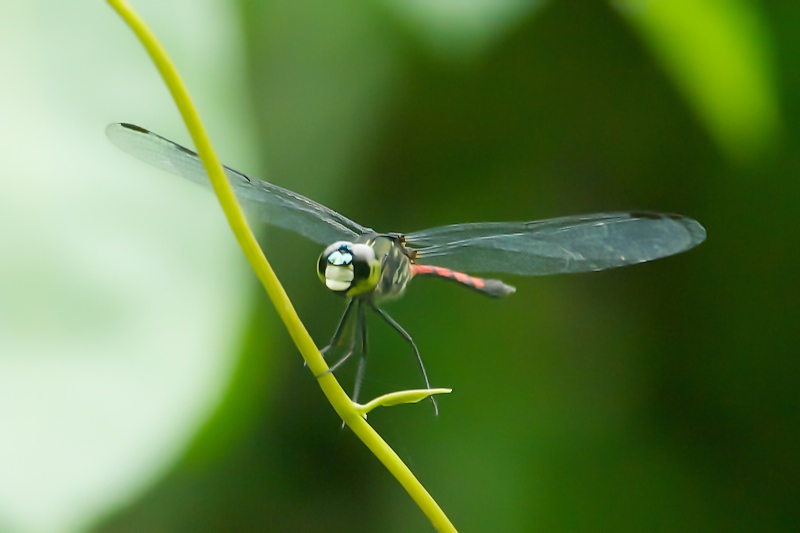
Wooded areas aren't normally the easiest places to find dragonflies (aside from forest specialists that I seem to have the devil of a time finding anyway), and there didn't appear to be a stream or pond in the immediate vicinity, but we nonetheless found a number of species patrolling the vegetation along our path. I'm not that great at identifying female (or young male) dragonflies, many of which look alike to me, but these appear to be one or the other of the common species of Neurothemis.
With the adult males, of course, the task of identification (at least to genus) is much easier. This is Neurothemis fluctuans, one of the commonest dragonflies in Singapore.
Orthetrum dragonflies are also a lot easier to identify as adult males. This is Orthetrum chrysis.
Females are a lot trickier (at least for me), though if you can get a good look at the wing vans toon it is normally easy to identify it to genus. Orthetrum has a complete antenodal cross win in the forewing (which means, in English, that the vein immediately in front of the wing node - the slight bend on the leading edge of the wing - completely crosses the first vein parallel to the wing edge instead of stopping short where the two veins meet).
Deciding which species you are dealing with is another matter. I think this one is a teneral (that is, newly emerged) female Orthetrum glaucum.
This dingy individual may be Orthetrum glaucum too, but I'm none too sure.
Agrionoptera insignis, on the other hand, is a lot easier to identify (and considerably harder to find, at least in my experience).
Here is one of the most distinctive of female dragonflies (and a true forest species): Tyriobapta torrida, called the Treehugger in Singapore. I usually find females perching on the trunk of a tree, doing their best to blend in to the bark. The strongly-patterned males would find this a lot more difficult to pull off (though they do try), and they are more likely to be defending territories around small forest ponds.
As Cynthia is demonstrating here, Treehuggers are apparently so sure of their camouflage that they will tolerate an extremely close approach. And this gives me an excuse to thank Cynthia, once again, for hauling me away from Royce's bedside to a bit of local nature - always the best way (for me at least) to relax in a trying personal situation.
This, by the way, is the 300th posting on A Wandering Naturalist. Thanks to my readers (should there still be any) who have stuck with me this far!
I try to keep the posts in this blog more or less chronological. However, one of the disadvantages of being perennially far behind in getting my travels written up is that sometimes my memory fails me - and if my photographic filing system fails me too, it means that I occasionally lose track of things that I wanted to share until after I have, in these accounts, passed them by. That is why, after telling you in my last entry about our traumatic and unexpected dash to our grandson Royce's bedside in Singapore in July 2014, I have to back up a bit. We'll return to Asia soon enough. For now, I invite you to step back with me to a peaceful Ontario June, a few weeks before our lives were consumed by a small boy's cancer on the other side of the world.

In June, the migrating songbirds that pour through southern Ontario in May have largely passed through, and the birder/naturalist is free to turn his (or her) attention to the emerging summer crop of dragonflies. That means, usually, finding water. The serene, reed-lined pond in this picture (and the one above), where I took these pictures on July 7/8, 2014, is not part of a reserve but lies only a few minutes from my house, on the University of Toronto's Mississauga campus.
It's hardly the Everglades, but it does attract its share of life. The bird flying over the water's surface above, and seated on a perch here, is a Northern Rough-winged Swallow (Stelgidopteryx serripennis), dullest-plumaged of Ontario's six breeding swallows.
Much to my surprise, the pond was low in dragonflies and/or damselflies. I was only able to photograph a few of the latter. These are Bluets (Enallagma sp.), members of S large, largely American damselflies that replace, by and large, very similar-looking insects in the Old World (Coenagrion, Pseudagrion, etc). Just to keep us on our toes, there are a few Enallagmas in Europe and a few Coenagrions in North America).
Unfortunately, the only way to identify most bluets with certainty is to study their genitalia with a hand lens (something I'm not sure that I even want to do with people). About the most you can do for the tough ones is to sort them out into general categories based on how much blue there is on the abdomen). There are three or four species in southern Ontario that look very much like this one.
However, for this male I may be able to make a call. The only one of the available lot of bluet species in the area with large, widely-splayed cerci - the upper processes of the male's copulatory apparatus - is the Familiar Bluet (Enallagma civile), and I think this photo shows that feature. In the other two the genitalia seem smaller and less splayed; if so, based on habitat, they might be Northern Bluets (E. annexum), in which the cerci are quite small and the lower processes, the paraprocts, are much more obvious. However, they could also be Vernal Bluets (E. vernale) or Boreal Bluets (E. boreale); without a specimen in hand it is almost impossible to tell.
There is no such trouble with the Eastern Forktail (Ischnura verticalis). We only have two of them in our neck of the woods, and they are quite easy to tell apart. Realizing that the female (above) and male (below) are members of the same species can be a little trickier.
Juvenal's Duskywing (Erynnis juvenalis) is one of our commoner skippers.
If only to convince me that yes, this was indeed wetland habitat. a young Great Blue Heron (Ardea herodias) dropped by...
...only to fly off to, perhaps, a more-fish-laden venue elsewhere.
Rocks and flowing water: a quite different wetland habitat. It is now a few weeks later, on June 23, 2014, and we are in the banks of the Credit River near my home, being serenaded (if you can call it that) by a male Red-winged Blackbird (Agelaius phoeniceus).
In the river itself are schools of Shiner (Notropis sp.), among the abundant little minnows that swarm in Ontario streams. There are a number of similar species, and I'm not sure which one this is.
A Green Frog (Lithobates clamitans) lounges in a quiet backwater.
The common damselfly here is the Powdered Dancer (Argia moesta). Their preferred habitat is a river with rocky banks.
The rocky banks of the Credit are mostly the result of people putting them there, but the damselflies don't seem to mind as long as they can sit and, presumably, sun themselves on the rocks. This one appears to be whiling away the time blowing bubbles (I wonder what it is really doing?).
Young female Powdered Dancers are mostly brown and black.
As the sexes age they become more pruinose - that is, covered in a pale powder (hence the name).
We came across several joined pairs in the course of our walk. This is probably not mating, but oviposition after mating has been completed. Powdered Dancers lay their eggs on stream vegetation, while the male stays in contact with her in case a male with other ideas happens by.
Some of the pairs were, in fact, would-be trios, with a rival male waiting to horn in.
Sometimes the rivals didn't bother to wait. This one seems to be trying, without much success, to dislodge the male.
Finally, though, he gave up, and left the courting couple to get on with their affairs in peace. These do seem about to mate; the female appears to be curling her abdomen forward to pick up sperm from the male's secondary genitalia.
The female Emerald Spreadwing (Lestes dryas)
is one of the stubbier-looking of its genus, but it is
attractively coloured in iridescent green. It is an extremely
wide-ranging species, the only one of its genus to be found in both the
Old and New Worlds: besides its North American range, it occurs across
much of temperate Europe and Asia.
We found a male Common Whitetail (Plathemis lydia) perched on a stem...
While a female flew over the river's surface, depositing her eggs in the water.

Our chief excitement in June, dragonflies aside, was a visit from Eileen's Aunt Freda and
Uncle Roland. As they are both proudly Sarawakian, we decided to use
the occasion for a drive north to Georgian Bluffs, just north of Owen
Sound, on June 27, 2014. Georgian Bluffs is a recent amalgamation of three former
municipalities, one of them known until the amalgamation as Sarawak,
Ontario. This may sound extremely odd, but the town owes its former name to a former Governor General of Upper Canada (as Ontario was then called) who was an uncle of James
Brooke, the first White Rajah of Sarawak. Though he seems to have been
under the impression that Sarawak was in India, he wanted to commemorate
his nephew's exploits - hence, Sarawak, Ontario (a bit of history
apparently unknown to its residents, but unearthed by Lim Kian Hock, an
indefatigable historical researcher from Kuching). Though Sarawak, Ontario, has vanished from the maps, the name lingers on about the area, here we are at the Sarawak United Church, flanking Deborah Murray, its (then) rector...

And here is how the church looked back when Sarawak, Ontario was still Sarawak.
We added some natural scenery to our excursion by stopping at Inglis Falls, an 18-metre-high waterfall in a Conservation Area of the same name near Owen Sound.
It's a scenic (and highly photographable) spot, as Eileen would surely tell you.
The moist edges of the river were ideal for Canada Anemone (Anemone canadensis), one of our commoner spring wildflowers.
I had hoped for a few dragonflies, particularly gomphids, but the only one I saw was the individual in this poor photograph of an insect in the parking lot. I flew off before I could get another shot, but I think it could be a Lancet Clubtail (Gomphus exilis), one of our commoner species.
I did better, though, with damselflies, in a reedbed along a quiet stretch of river above the falls.
Here I found my first River Jewelwing (Calopteryx aequabilis), the less common of our two native Calopteryx (the other, the Ebony Jewelwing (C. maculata), has broader, entirely-black wings). This one, with its emerald-green body and black-tipped wings, is a male.
This one, with its shining white stigmas, is a female.
On the way back to the others I found this peculiar insect clinging to a reed. It is a Dark Fishfly (Nigronia fasciata), a member of the dobsonfly family (Corydalidae). Like dragonflies, fishflies spend their larval lives as underwater carnivores, sometimes for two or three years. Once they emerge as adults, though, they may not feed at all, and usually live for only about ten days or so.
As I emerged back onto the lawn near the parking lot I came across an American Robin (Turdus migratorius) sunning itself on the grass - a dooryard bird I was soon to leave behind as Eileen and I headed for Singapore.
It was only a few days later, on July 2, 2014, that we found ourselves at the airport, with Davin seeing us off and Freda and Roland left to their own devices at home. If you read my last post you will know what came next - at least from a naturalists' point of view - and with that, we can now return to our proper chronological sequence.