The Frog Pond at Kubah National Park is a spot I am always glad to revisit. On October 8, 2014, I only had time to spend an hour or so there - not a very long stop, but enough to revisit some of the pond's usual insect habituees (to see the frogs that have made the pond famous, you have to visit after dark).
There is almost always at least one male Cratilla metallica there, guarding its territory from a vine dangling over the water.
Tyriobapta torrida males are often numerous at the pond, chasing each other about and pursuing females as they drop their eggs into the water before resuming their usual perch on a nearby tree trunk (as in the lower picture). These dragonflies have strong preferences as to where they perch, both in terms of which tree they choose and how high up on the tree they sit.


The females, posing vertically as though they were a sort of darner (Aeshnidae) rather than a typical libellulid dragonfly, blend in remarkably well with the bark of their chosen perches. The far more conspicuous males do perch on trunks when they are not at their breeding sites. According to one study (the one linked to above) they leave their perches for their territories earlier in the morning than females and may not return until after 6 PM. Males appear to have sacrificed the advantages of camouflage in the name of acquiring territories and attracting mates. Sexual selection, something first proposed by Darwin, is widely accepted today. I don't know if Tyriobapta torrida has been promoted as an example of it - though it appears to be a particularly apposite one.

This object, which I found wedged into the boardwalk that circles the pond, appears to be the remains of an egg mass from one of the rhacophorid frogs that resort here by night to breed. This particular attempt seems to have been a failure, though it certainly has provided a bonanza for the assortment of flies crawling over it.
The bonanza was also appreciated by this Great Marquis (Euthalia [Bassarona] dunya), a nymphalid butterfly.
Northerners may not be used to the idea of butterflies as scavengers, but there are many tropical butterflies, particularly forest floor nymphalids, for whom carrion is an important food and, possibly nitrogen (but see this study), source. Butterflies like these may rarely, if ever, visit flowers.
Finally, I found this Heliocypha biseriata female - but at the road edge. These damselflies like running water with stones to perch on, and the pond is probably too muddy and still for their tastes.
Fairy Cave, near Bau in western Sarawak, is one of the better-known examples of Borneo's Karst topography - limestone permeated and dissolved by rainwater into a series of extensive underground cave systems.
Fairy Cave is popular among the local rock-climbing fraternity, who journey out from Kuching in order to risk their necks scaling the limestone cliffs. Among them is my friend Hans Breuer's son Hans Junior, and on October 5, 2014, Hans invited Ryan and I to travel up to the cave with him. Naturally. as a confirmed acrophobiac I had no intention of joining the climb (and as a totally unprepared amateur, I wouldn't have been allowed to do do anyway). Ryan was obviously too little. So while he watched the climbers, I decided to see what I could see near the cave entrance.
First, of course, the cave itself had to be explored.
The broad entrance lets a fair bit of light into the interior, allowing visitors to appreciate the cave by natural light.
The light also allows a surprising amount of vegetation, from vines to mosses, to grow well past the cave mouth.
Fairy Cave's name is a reference to a formation near the entrance that supposedly resembles a Chinese deity. I'm not at all sure if one of these calcite columns is the one that they mean, though.
Some of the patches of green on the cave walls are not signs of plant life, but of coloured minerals.
Outside the cave, lianas and other vegetation scale the limestone cliffs. They include some rare endemics, including a highly sought-after (and, as a consequence, Critically Endangered) slipper orchid (Paphiopedilum stonei).
As usual, I was reduced to photographing plants I could not identify, including this forest fruit...
...and this herbaceous flower.
The Commander (Moduza procris) is a butterfly that I usually find (though I don't find it too often) where there are rocky areas; it seems to prefer to bask on rocks or bare ground. Unlike a number of other Asian forest-edge nymphalids, but like it's near relatives the admirals (Limenitis) it does visit flowers (as these photos show) and avoids carrion and rotten fruit.
The Rustic (Cupha erymanthis) is another reasonably common forest-edge butterfly, like the Commander a member of the family Nymphalidae.
The Fluffy Tit (Zeltus amasa), by contrast, is a hairstreak (Lycaenidae), one of a number of similar-looking butterflies in the region. I see it far less often than the commonest of the group, the Branded Imperial (Eooxylides tharis), so I was particularly pleased to encounter this one as it searched for mineral salts in the cave parking area. The black-and-white banding on its legs somehow adds to its overall cuteness (at least to my eyes).
Dragonflies near the cave mouth included, once again, the common Neurothemis ramburii...
...and it's equally common cousin, Neurothemis terminata.
This rather featureless dragonfly, however, I failed to recognize, and it was only some time later that I was able to identify it as a female of Tholymis tillarga - she looks quite unlike the bright red male, and lacks his striking black-and-white wing patches. This is a late-afternoon and dusk-flying dragonfly, and resumably she was waiting for the sun to decline in the sky before taking to the air.
I found myself drawn to the little stream that flows in front of the cave entrance. The banks of the stream were particularly rich in damselflies...
...including this male Vestalis sp. [July 2017: this is actually a female Neurobasis longipes].
Heliocypha biseriata was common, as it is on similar streams throughout the area. I photographed a number of males like this one...
...and females like these.
Some of the males, though, were distinctly odd-looking, with the usually bright pink shoulder patch tending to a dull orange. Are these simply immatures, or something else? [2017/7 update: immature males, according to Rory Dow]
Among the smaller damselflies I found Prodasineura verticalis, a common species around Kuching (as readers of earlier posts will know)...
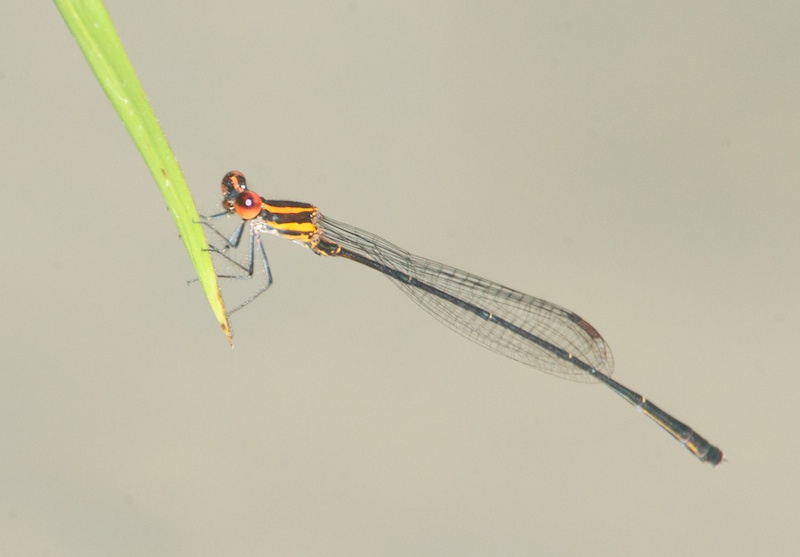
...as wel as Agriocnemis femina, a tiny species that I had previously seen only in Singapore, where it is called the Variable Wisp.
These are both Copera vittata; the upper individual is a so-called "ghost", actually a teneral or recently-emerged adult yet to acquire its mature colours. I have seen this species at the MJC forest, where it seems to keep well under over to avoid ending up in the jaws of the dominant damselfly there, Ceriagrion cerinorubellum. I saw none of these predators at Fairy Cave, so perhaps the Copera damselflies at Fairy Cave were more confident about perching in the open.